Analysis of the final chapter of Moby-Dick — the three-day chase, the sinking of the Pequod, and the meaning of the ending.
🐋
Moby-Dick Chapter 135: The Chase — The Ending Explained
Analysis of the final chapter of Moby-Dick — the three-day chase, the sinking of the Pequod, and the meaning of the endi...
The Final Chapter
Chapter 135 of Moby-Dick, “The Chase — Third Day,” is one of the great endings in literature. After 134 chapters of buildup, the confrontation is brief, violent, and devastating.
Day One
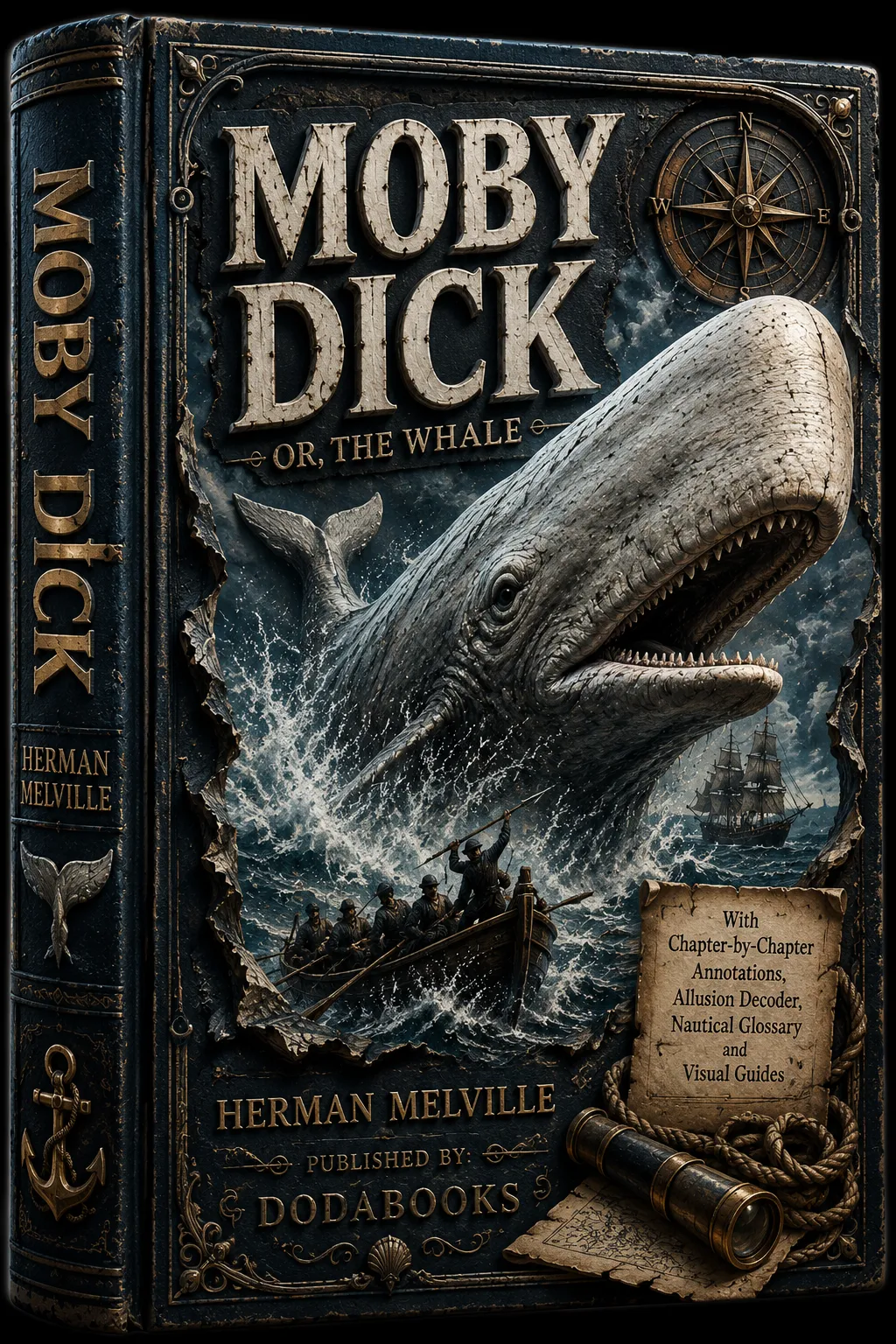
📖 Want the complete annotated experience?
👉 Get the Annotated EditionOn the morning of the first day, the lookout spots Moby-Dick’s spout — “There she blows!” — and Ahab orders the boats lowered. The cry sends a shock of adrenaline through the Pequod’s crew; after weeks of searching, the white whale is finally within reach, and the tension that has been building since Ahab first nailed the gold doubloon to the mast reaches a breaking point. The chase begins with explosive energy. Ahab’s boat approaches the whale, but Moby-Dick proves far more cunning than expected. The whale turns with terrifying speed, his jaws open, and smashes Ahab’s whaleboat to splinters. The crew is scattered in the water, but fortunately all are rescued by the other boats. Ahab, soaking wet and clinging to a piece of wreckage, is hauled back aboard the Pequod. He is completely undeterred. “Towards thee I roll, thou all-destroying but unconquering whale,” he declares, already planning the next day’s assault. The first day establishes the pattern: Ahab will not yield, and the whale will not flee. It is a contest of pure will, and neither side possesses the capacity for surrender. The crew watches in awe and terror as their captain commits them to a second day of battle with a creature that has already demonstrated its devastating power. The sun sets on the first day with the Pequod damaged but still afloat, and Ahab pacing the deck like a caged animal, his ivory leg clicking against the planks with each restless turn.
Day Two
The second day of the chase is even more violent and desperate than the first. Moby-Dick attacks with renewed fury, destroying two of the whaleboats and scattering the crew once again. Ahab’s own boat is smashed for a second time, and in the chaos, the old captain is thrown against the gunwale, fracturing his ivory leg. The pain is excruciating — you can hear it in his cries, in the way he grips the broken remains of his prosthetic limb. Yet Ahab refuses to return to the ship. He orders the boats reassembled, insists on continuing the pursuit, and even refuses medical treatment from the ship’s surgeon. “I am madness maddened!” he declares, and the words are not bravado but diagnosis. The whale sounds deep and disappears beneath the waves, leaving Ahab circling the empty ocean, bleeding, broken, but still consumed by his monomaniacal purpose. The second day reveals the true cost of Ahab’s obsession — he is willing to sacrifice his own body, his health, his life, for the chance at one more throw of the harpoon. The crew begins to understand that this is no longer a hunt but a death wish disguised as a pursuit. Starbuck watches from the quarter-deck with mounting horror, understanding that his captain has crossed a line from which there is no return — that Ahab will destroy them all before he yields, and that the only question remaining is whether the crew will die obeying orders or die trying to stop him. The second day ends not with the crash of whaleboats but with a terrible silence, the Pequod circling an empty ocean while Ahab mutters prayers to a God he no longer believes in.
Day Three
The third and final day of the chase is the climax of the entire novel — the moment toward which 134 chapters of buildup have been relentlessly driving. This time, Moby-Dick does not wait for the whaleboats to approach. The whale charges directly at the Pequod itself, ramming the hull with catastrophic force. The ship shudders, timbers crack, water begins to pour in. Ahab, standing in his boat, hurls his harpoon with one last, desperate effort. The harpoon strikes true — but the line, attached to the whale, catches around Ahab’s neck. In a single, terrible motion, he is dragged overboard and into the churning sea. His final gesture is almost symbolic: he nails a sea hawk to the mast with his hand, as if trying to leave one last mark of defiance against the sky. The Pequod, fatally wounded, begins to sink. The great ship that has been Ahab’s floating kingdom, his stage, his instrument of vengeance, slides beneath the waves and disappears. The tragedy is complete — captain and crew, ship and purpose, all consumed by the whale they sought to destroy. The brevity of the final day’s action, compressed into just a few pages after hundreds of pages of preparation, is one of the most devastating structural choices in all of literature.
Ishmael’s Survival
In the midst of this catastrophe, one figure survives — Ishmael, the narrator, the observer, the man who has been our guide through this extraordinary voyage. On the first day of the chase, Ishmael was thrown from Ahab’s boat when it was smashed by the whale. He clings desperately to Queequeg’s coffin-buoy, the extraordinary device that the Polynesian harpooneer had commissioned before his death and that was later converted into a life preserver when his apparent illness proved temporary. The symbolism is breathtaking: the friend who loved Ishmael in life saves him even in death. For an entire day and night, Ishmael floats alone on the empty ocean, surrounded by the debris of the wreck, watching the sea swallow everything he has known. The experience is both physical ordeal and spiritual transformation — he is stripped of everything, reduced to pure survival, and in that reduction, he discovers something essential about human existence. When the whaling ship Rachel finally rescues him, he is “the only living soul” to emerge from the disaster. He has survived not through courage or strength but through the love of a dead friend — a love that proved more durable than Ahab’s all-consuming hatred. Ishmael’s survival is the novel’s final and most powerful statement about the nature of meaning in a universe that seems determined to resist it. He exists to tell the story, to bear witness, to ensure that the catastrophe is not forgotten. The act of narration itself becomes an act of defiance — a refusal to let the void have the last word.
The Meaning
The ending of Moby-Dick resists easy interpretation, and that is precisely its power. The whale wins, but at what cost? Moby-Dick escapes with the harpoon still embedded in his flank, but he is grievously wounded — his next encounter with whalers may well be his last. Ahab dies defiant, never yielding, never recognizing the futility of his quest. He sinks into the Pacific with a curse on his lips, and the ship he commanded slides beneath the waves, taking with it every soul aboard except one. The final line of the chapter is among the most devastating in all of literature: the whaling ship Rachel, “searching for her lost children, only found another orphan.” Ishmael survives, but his survival is not triumph — it is testimony. He exists to tell the story, to bear witness to what happened, to ensure that the catastrophe is not forgotten. In this sense, the act of storytelling itself becomes the novel’s ultimate victory over meaninglessness. The whale’s whiteness may represent an indifferent universe, but Ishmael’s narrative insistence on recording, interpreting, and sharing his experience is a defiant assertion that human consciousness matters, that suffering deserves to be witnessed, that the act of bearing witness is the only victory possible in a world where the whale always wins.
The ending also functions as a judgment on Ahab’s monomania — not through moral pronouncement but through the sheer, devastating consequences of his choices. Every decision Ahab made throughout the novel — nailing the doubloon, swearing the crew to his oath, refusing Starbuck’s pleas to turn back — leads inexorably to this moment of total destruction. The Pequod does not merely sink; it is dragged down by the whale, pulled into the abyss by the very instrument of Ahab’s vengeance. The harpoon line that kills Ahab is attached to Moby-Dick — Ahab is literally destroyed by his own obsession, entangled in the very weapon he used to pursue it. This is tragedy in its purest form: the hero’s downfall is the direct and inevitable consequence of his defining characteristic. Ahab could not be Ahab without his defiance, and his defiance could not lead anywhere but here — to the bottom of the Pacific, to oblivion, to the silence of the deep.
Discover the depth of Melville’s masterpiece with our annotated edition of Moby-Dick. Complete text with explanatory notes, historical context, and literary analysis.
📚 Related Articles
Frequently Asked Questions
What happens on the third day of the chase in Chapter 135?
Moby Dick turns and rams the Pequod, sinking the ship, while Ahab is strangled by the harpoon line and Ishmael alone escapes on Queequeg's coffin-buoy.
How does Ishmael survive the sinking of the Pequod?
Queequeg's carved cedar coffin floats up from the vortex of the sinking ship, providing Ishmael with a life buoy until the Rachel rescues him.
Why did the Pequod sink?
Moby Dick directly stove in the timbers of the bow, breaking the ship's hull in a deliberate, retaliatory counter-attack.
What is the symbolic significance of Queequeg's coffin?
The coffin transforms from an emblem of mortality into a vessel of resurrection and salvation, symbolizing life emerging from death.
Where can I read an annotated guide to the climax of Moby-Dick?
The DodaBooks annotated edition offers an exhaustive breakdown of the final chase, nautical maneuvers, and symbolic resolutions.
🎯 Stop Struggling. Start Understanding.
The annotated edition of Moby-Dick gives you everything you need to finally get Melville’s masterpiece:
- ✅ Complete, unabridged text — every word of the original 1851 edition
- ✅ Hundreds of explanatory footnotes — no more Googling every other page
- ✅ Historical context — the Essex disaster, Nantucket whaling, Melville’s life
- ✅ Literary analysis — chapter-by-chapter commentary on themes and symbols
- ✅ Victorian vocabulary — obsolete words and nautical terms defined inline
- ✅ Biblical & literary references — every allusion traced to its source