Analysis of Moby-Dick Chapter 1: ‘Loomings.’ Why this chapter is a perfect introduction to Ishmael, the sea, and Melville’s themes.
🐋
Moby-Dick Chapter 1: 'Loomings' — Analysis and Summary
Analysis of Moby-Dick Chapter 1: 'Loomings.' Why this chapter is a perfect introduction to Ishmael, the sea, and Melvill...
The Most Famous Opening
“Call me Ishmael.” With three words, Moby-Dick begins. Chapter 1, “Loomings,” is one of the great opening chapters — not for plot but for voice, themes, and narrator psychology.
The opening line is deceptively simple. “Call me Ishmael” — not “My name is Ishmael” or “I am called Ishmael.” The verb “call” introduces immediate ambiguity: is this his real name? A pseudonym? A role he is inviting us to play? The phrase suggests that identity itself is a matter of performance, a story we tell rather than a fact we possess. This uncertainty establishes the novel’s philosophical tone from the very first sentence.
The name “Ishmael” carries its own weight. In the Bible, Ishmael is the outcast son of Abraham — born to a servant, expelled from the family, doomed to wander. Melville chose this name deliberately: his narrator is a wanderer by nature, a man who cannot settle into conventional life. The biblical resonance also hints at the novel’s larger themes: exile, survival, and the search for meaning in a hostile world. By naming his narrator Ishmael, Melville signals that this will be a story about outsiders — men who exist on the margins of society and find their truest selves in the wild spaces of the earth.
The opening sentence also establishes the novel’s narrative contract: Ishmael is speaking directly to us, inviting us into a relationship that is both intimate and provisional. He does not command; he suggests. He does not demand; he asks. This conversational tone will carry us through 600 pages of adventure, philosophy, and tragedy. From the first sentence, Ishmael makes us feel that we are not passive readers but active participants in the story he is about to tell.
The First Paragraph
Ishmael explains why he goes to sea: “Whenever I find myself growing grim about the mouth; whenever it is a damp, drizzly November in my soul… then, I account it high time to get to sea.” This is not rational — it is impulse. He goes to sea the way others take a vacation.
The passage is one of the most quoted in American literature, and for good reason: it captures something essential about the human relationship to melancholy. Ishmael does not go to sea because he wants adventure or profit; he goes because his soul has turned gray, because the world has become too much to bear on land. The sea is not his destination but his antidote — a space where the heaviness of existence can be temporarily dissolved by the rhythm of waves and the vastness of the horizon.
The metaphor of “a damp, drizzly November in my soul” is extraordinarily precise. November in New England is a month of bare trees, gray skies, and the first hints of winter — a time when nature withdraws and the world feels emptied of possibility. Ishmael experiences this emptiness internally: his soul has entered its own November, and the only remedy is the sea. This metaphor establishes the novel’s central theme: the relationship between inner states and outer landscapes, between the geography of the soul and the geography of the earth.
The passage also reveals Ishmael’s self-awareness and humor. He knows that going to sea is not a rational response to melancholy, but he does it anyway. He describes himself as a “substitute for pistol and ball” — suggesting that without the sea, he might resort to violence or suicide. This dark humor is characteristic of Ishmael’s narrative voice: he can laugh at his own despair, which is what makes him a trustworthy guide through the novel’s darker territories. He does not pretend to be sane; he simply finds ways to live with his insanity.
Ishmael’s Philosophy
He quotes Cato and mentions Plato. He is educated, thoughtful, and prone to philosophical digression — a preview of the narrative voice that will carry the entire novel.
Ishmael’s philosophical references are not random decorations — they are carefully chosen to establish his intellectual credentials and to frame the novel’s central questions. Cato the Elder’s advice to “always have a retreat in mind” suggests that Ishmael sees the sea as a strategic withdrawal from civilization, not an escape but a tactical retreat. Plato’s observation about the sea making people foolish (“φιλομυθοι” — lovers of myths) is a warning and an invitation: the sea will make Ishmael tell stories, and those stories may not be reliable.
These references also establish that Ishmael is a reader as well as a sailor — a man whose mind is stocked with books, ideas, and arguments. He is not an uneducated laborer but a self-taught intellectual, a man who has read widely and thought deeply about the world. This combination of physical experience and intellectual curiosity makes him the ideal narrator for a novel that is simultaneously an adventure story and a philosophical treatise. He can describe the mechanics of whaling and the metaphysics of the sea with equal authority.
Ishmael’s digressions also serve a structural purpose: they slow the reader down, forcing us to engage with ideas rather than just events. In a lesser novel, these passages would be tedious; in Moby-Dick, they are essential to the experience. Melville uses Ishmael’s philosophical voice to remind us that the story is not just about what happens but about what it means — and that meaning is always a matter of interpretation, never a matter of fact.
Themes Introduced
- Water as a symbol — the “universal cannibalism of the sea”
- Fate and free will — Ishmael seems driven by forces he does not understand
- The outsider — Ishmael is a wanderer, an exile
These three themes are the pillars of the entire novel, and Melville establishes all of them in the opening chapter.
Water as symbol: The sea in “Loomings” is not just a physical space but a metaphysical concept. Ishmael describes it as a place of “universal cannibalism” — a phrase that suggests the natural world is fundamentally predatory, that life feeds on life in an endless cycle without moral purpose. This vision of nature as amoral and indifferent will haunt the entire novel, reaching its climax in the white whale’s final attack on the Pequod. The sea is not hostile; it is simply unconcerned with human survival.
Fate and free will: Ishmael insists that he goes to sea voluntarily, yet his language suggests otherwise. He describes the sea as a “magnet” that draws him irresistibly, as if he were a needle on a compass pointing toward an inevitable destination. This tension between choice and compulsion — between the feeling of freedom and the reality of necessity — is central to the novel’s exploration of fate. Is Ahab choosing to hunt the whale, or is he being driven by forces beyond his control? The question has no easy answer, and Melville wants it that way.
The outsider: Ishmael is not just a sailor but a perpetual exile — a man who cannot find a permanent home in civilization. His desire for the sea is a desire for a world without fixed addresses, without social hierarchies, without the constraints of conventional life. The sea is the last place where a man can be truly free — and truly alone. This longing for freedom and solitude will define Ishmael’s character throughout the novel, even as his friendship with Queequeg teaches him that connection is also essential to survival.
Why It Works
The chapter makes us trust Ishmael. He is intelligent, self-aware, and slightly self-deprecating. By the end of “Loomings,” we are ready to follow him anywhere — including onto a whaling ship with a mad captain.
The chapter works because it establishes a relationship between narrator and reader. Ishmael does not demand our trust; he earns it, through honesty, vulnerability, and wit. He admits that his reasons for going to sea are not rational; he acknowledges his own melancholy and his need for escape. This self-deprecation makes him endearing and believable — a man we want to know, even if we would not want to be him.
The chapter also works because it raises questions without answering them. Why does Ishmael go to sea? What is he looking for? Will he find it? These questions create narrative momentum — not the momentum of plot (nothing dramatic happens in “Loomings”) but the momentum of curiosity. We want to know what happens to this man, not because we expect adventure but because we expect insight. Ishmael has promised to show us something — the sea, the whale, the world beyond civilization — and we believe he can deliver.
Finally, the chapter works because it sets the tone for everything that follows. The language is rich but not pretentious; the ideas are profound but not obscure; the humor is dark but not bitter. This balance — between depth and accessibility, between seriousness and play — is what makes Moby-Dick a novel that rewards rereading. Every time we return to “Loomings,” we find new details, new meanings, new reasons to follow Ishmael to the ends of the earth.
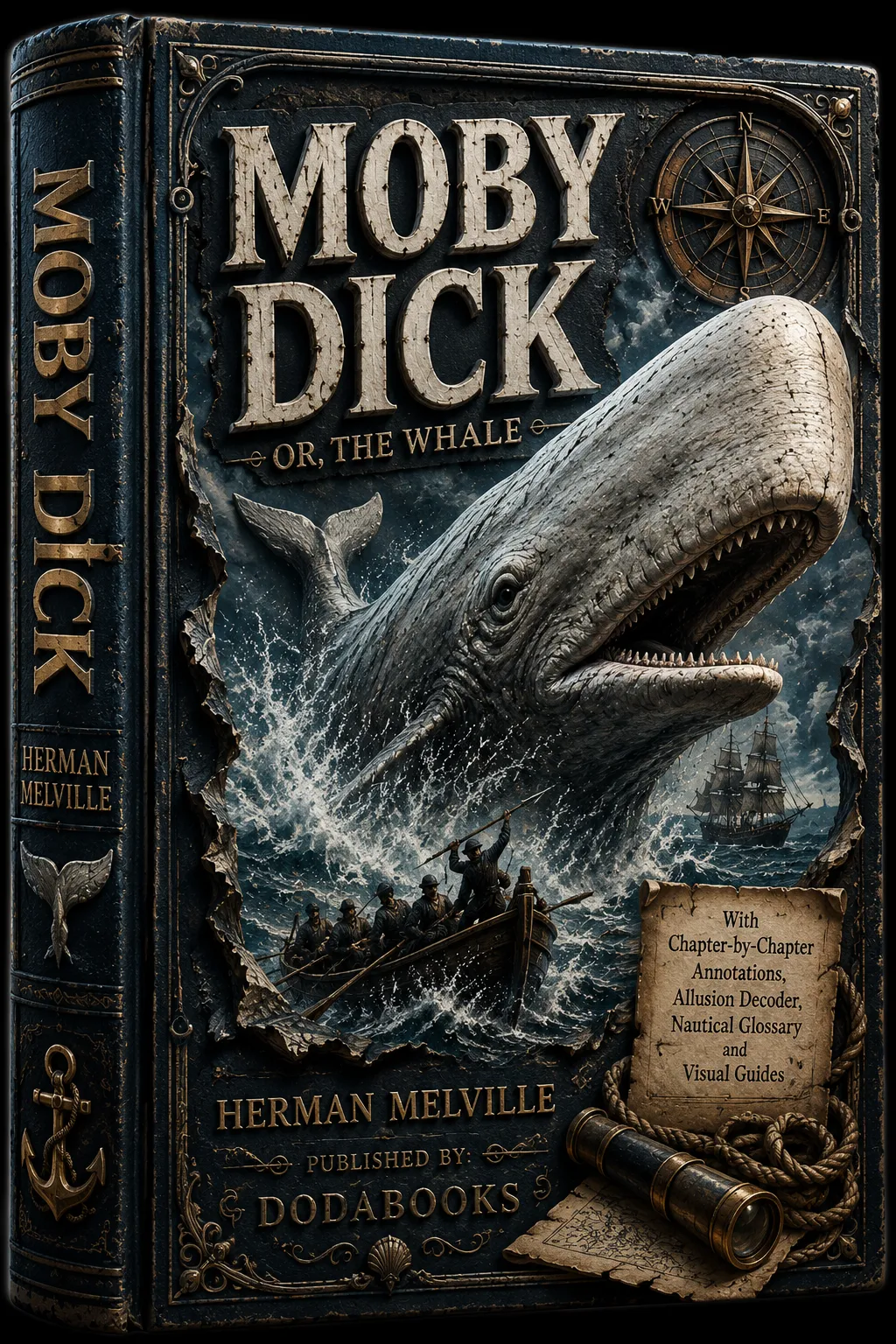
Discover the depth of Melville’s masterpiece with our annotated edition of Moby-Dick. Complete text with explanatory notes, historical context, and literary analysis.
📚 Related Articles
Frequently Asked Questions
What does 'Loomings' mean in Chapter 1?
'Loomings' is a nautical term referring to an atmospheric optical illusion where distant objects appear distorted or elevated above the horizon, foreshadowing ominous events.
Why does Ishmael go to sea whenever he feels depressed?
Ishmael views the sea as his substitute for 'pistol and ball'—a therapeutic venture that purges his suicidal impulses and existential dread.
What famous meditation on water occurs in Chapter 1?
Ishmael observes that crowds of city dwellers naturally gravitate toward the water's edge, concluding that water symbolizes meditation and the infinite soul.
Who is Narcissus and why is he mentioned in Chapter 1?
Melville cites the myth of Narcissus to suggest that when humans gaze into the ocean, they perceive the ungraspable phantom of their own inner life.
How does the DodaBooks edition enrich Chapter 1?
It provides comprehensive glosses on 19th-century New York topography, philosophical allusions, and psychological subtexts right on the page.
🎯 Stop Struggling. Start Understanding.
The annotated edition of Moby-Dick gives you everything you need to finally get Melville’s masterpiece:
- ✅ Complete, unabridged text — every word of the original 1851 edition
- ✅ Hundreds of explanatory footnotes — no more Googling every other page
- ✅ Historical context — the Essex disaster, Nantucket whaling, Melville’s life
- ✅ Literary analysis — chapter-by-chapter commentary on themes and symbols
- ✅ Victorian vocabulary — obsolete words and nautical terms defined inline
- ✅ Biblical & literary references — every allusion traced to its source