Honest Moby-Dick book review for modern readers. Is the classic worth your time in 2026? We examine its challenges and rewards for today’s audience.
🐋
Moby-Dick Book Review: Does It Still Live Up to the Hype in 2026?
Honest Moby-Dick book review for modern readers. Is the classic worth your time in 2026? We examine its challenges and r...
The Reputation Problem
Moby-Dick has a reputation problem. It is the book everyone says is the greatest American novel but fewer people have actually read. The jokes write themselves: it is long, full of whale facts, and that one book your English teacher insisted you read.
So does it actually hold up in 2026?
The answer is complicated — and more interesting than a simple yes or no. Moby-Dick is not a book that “holds up” in the way that a good thriller holds up. It is not designed to be consumed and forgotten. It is designed to be wrestled with, argued over, returned to, and rediscovered. The question is not whether it is good. The question is whether you are ready for what it demands.
Every generation rediscovers Moby-Dick. In the 1920s, critics like Carl Van Doren and D.H. Lawrence rescued it from decades of neglect and declared it a masterpiece. In the 1940s, F.O. Matthiessen canonized it as the Great American Novel in his landmark study American Renaissance. In the 1960s, it became a countercultural touchstone, a book about rebellion and obsession that spoke to a generation questioning authority. Each era finds in Moby-Dick what it needs — which is itself evidence of the novel’s extraordinary depth.
The hype, in other words, is not manufactured. It is earned. The problem is that Moby-Dick requires something from its readers that most modern books do not: patience, attention, and a willingness to be confused. It asks you to slow down, to sit with difficulty, to trust that the chapters that seem irrelevant will eventually reveal their purpose. In an age of scrolling and skimming, this is a tall order.
The Challenges
📖 Want the complete annotated experience?
👉 Get the Annotated EditionLet’s be honest: Moby-Dick is not an easy read. The cetology chapters can feel like homework. The language is dense, 19th-century prose. The pacing in the middle section is slow by modern standards.
But every difficulty is intentional. Melville wanted to immerse you in the world of whaling so completely that you feel the salt spray and the weight of Ahab’s obsession. He wanted the novel to be an experience, not just a story.
The cetology chapters — the extended digressions on whale anatomy, whale behavior, and the history of whaling — are the most commonly cited obstacle. They break the narrative flow at critical moments, pausing the adventure to deliver what amounts to a mini-encyclopedia of whale science. First-time readers often skim them, and that is fine. But on a second or third reading, these chapters reveal their purpose. They build the world of the novel from the ground up, giving the reader the same obsessive knowledge of whales that Ahab himself possesses. By the time the chase begins, you do not merely watch it. You understand what a whale is, what its blubber feels like, what its blood smells like, what it means to pursue one across the ocean.
The language is another challenge. Melville’s prose is dense, allusive, and often deliberately archaic. He writes in a register that mixes theatrical rhetoric, Biblical cadence, and nautical slang. Sentences sprawl across paragraphs. Metaphors pile upon metaphors. The effect is overwhelming, and that is the point. Melville wanted the novel to feel as vast and uncontrollable as the ocean itself. He wanted the prose to mirror the experience of being at sea — disorienting, exhilarating, and sometimes terrifying.
The Rewards
When Moby-Dick works — and it works often — it is transcendent. “The Quarter-Deck” is a masterclass in dramatic tension. “The Whiteness of the Whale” is a philosophical essay that prefigures existentialism. The final three-day chase is as gripping as any thriller.
The characters are unforgettable: Ahab, the monomaniacal captain; Queequeg, the noble harpooneer; Starbuck, the voice of rational caution; and Ishmael, the observant narrator who survives to tell the tale.
But the novel’s greatest reward is the sense of having been changed by reading it. Moby-Dick is not a book you finish and forget. It stays with you. The images — the white whale rising from the deep, Ahab standing at the prow, Ishmael clinging to the coffin — lodge in the imagination and refuse to leave. The questions the novel raises — about obsession, about the limits of knowledge, about the relationship between humanity and nature — do not have easy answers. They follow you, the way the ocean follows a sailor long after he has returned to land.
There is also the sheer pleasure of Melville’s prose at its best. When the language catches fire — in Ahab’s speeches, in the descriptions of the whale hunt, in the philosophical meditations — it achieves a power that few novelists have ever matched. The famous opening of Chapter 1, “Call me Ishmael,” is a masterclass in narrative voice. The soliloquies in “The Quarter-Deck” are among the most powerful in American literature. The final chase sequence builds with a relentless, almost musical intensity that leaves the reader breathless.
And there is the humor. This is often overlooked, but Moby-Dick is frequently very funny. Stubb’s dry wit, Flask’s complaints, the absurd debates among the crew about the nature of whales — these moments of comedy lighten the darkness and remind us that the novel is, among other things, a story about people living and working together on a small ship in the middle of the ocean.
Verdict
Moby-Dick is absolutely worth reading in 2026. It is not a book you consume; it is a book that consumes you. And with a good annotated edition, the difficulties become gateways rather than barriers.
The honest assessment is this: Moby-Dick will change the way you think about novels, about language, about storytelling itself. It is not a book for every mood, or every moment, or every reader. But for those who are willing to meet it on its own terms — who are willing to slow down, to be patient, to trust that the difficulty is not punishment but invitation — it offers rewards that no other novel can match.
The hype is real. The whale is real. The voyage is real. The only question is whether you are ready to set sail.
🌍 Why Moby-Dick Still Matters in 2026
You might reasonably ask why an 1851 whaling novel should matter to readers in 2026. The surface setting — sailing ships, harpoons, spermaceti candles — feels remote. But strip away the whaleboats and Moby-Dick is startlingly modern. It is about humanity’s relationship with nature long before such concerns had a name, about industry grinding up both the ocean and the men who work it, and about obsession. When Ahab insists the whale is “all a damned monster” that must be conquered, he voices an attitude toward nature our own century is learning to question — one reason every generation finds new meaning here. Our analysis of the novel’s many genres shows how comedy, tragedy, essay, and drama share a single text, which is why readers still argue about it more than 170 years on.
🧭 Who Should Read It — and Who Should Skip It
Let’s be honest about the audience, because a good review tells you when not to read something. If you want a fast, plot-driven novel for a commute, Moby-Dick is the wrong book today; it is slow, digressive, and demands attention. Save it for a time when you can settle in. But if you love a book that makes you think, that resists you, that rewards a second pass, Moby-Dick is almost certainly for you. Manage expectations and read strategically — our beginner’s guide and reading tips breaks the novel into stages, and our 30-day reading schedule turns it into a manageable daily habit.
🎓 How to Read Moby-Dick Without Getting Lost
Begin wherever keeps you moving. The opening chapters introduce Ishmael and Queequeg and are the most approachable; the real hurdle is the middle, when the cetology chapters pause the story for whaling science. Do not fight them — skim on a first read if you must. Let our chapter-by-chapter summary remove the anxiety of being lost so you can enjoy the language, and check the character guide to know every face on the Pequod before they step into the narrative.
🎬 The Adaptations vs. the Book
Many readers arrive at Moby-Dick through an adaptation — the 1956 film with Gregory Peck as Ahab, or any number of stage and screen versions. If that is you, the novel will feel both familiar and strange. Adaptations compress drama; the book is vastly stranger, funnier, and more digressive than any film can capture. The 1956 movie, honestly reviewed in our look at the Gregory Peck Ahab, fixed the white whale in the popular imagination but left out much of Melville’s deepest material. The constant round of remakes — from Star Wars to The Simpsons — is itself proof of the novel’s staying power.
❓ Frequently Asked Questions
Is Moby-Dick actually hard to read?
It can be, and the difficulty is partly the point. The prose is dense 19th-century English, and the middle sections pause the story for long stretches of whaling science. But it is not impenetrable — with an annotated edition and a reading schedule, most readers find it far more approachable than its reputation suggests.
Should I read the annotated edition or the plain text first?
For a first read, the annotated edition is the better choice. Melville’s vocabulary, historical references, and Biblical allusions can baffle without guidance, and stopping to Google every page breaks the spell. Annotations remove that friction so you stay inside the story.
How long does it take to read Moby-Dick?
The unabridged novel runs about 720 pages. At 30–40 pages per hour, most readers finish in roughly 18–24 hours of reading, often spread over several weeks. Treating it as a daily habit of a few chapters makes it far less daunting.
Is the ending worth the journey?
Yes — the final three-day chase is among the most celebrated sequences in American literature, and most readers agree it justifies the voyage. Our explanation of the final chase walks through what happens and what it means.
Does Moby-Dick have a plot, or is it just whale facts?
It has both. Underneath the digressions is a tight, compulsive story — a whaling voyage, a captain obsessed with a single whale, a hunt that resolves in a dramatic three-day chase. The whale facts are the world-building; the plot is what carries you through it.
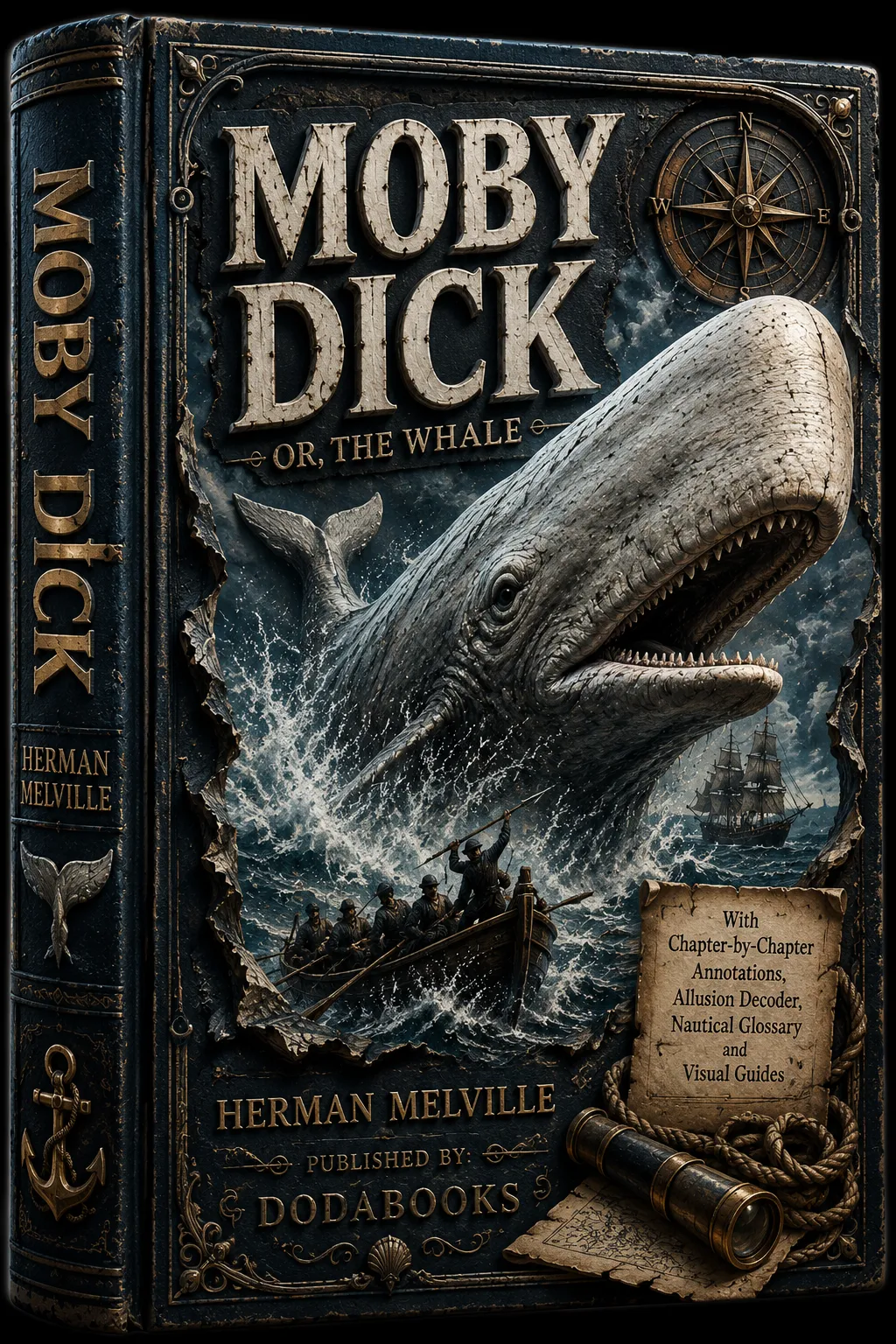
Discover the depth of Melville’s masterpiece with our annotated edition of Moby-Dick. Complete text with explanatory notes, historical context, and literary analysis.
📚 Related Articles
For readers intrigued by behind-the-scenes trivia and bizarre historical details, see our breakdown of 10 Things You Didn’t Know About Moby-Dick.
🎯 Stop Struggling. Start Understanding.
The annotated edition of Moby-Dick gives you everything you need to finally get Melville’s masterpiece:
- ✅ Complete, unabridged text — every word of the original 1851 edition
- ✅ Hundreds of explanatory footnotes — no more Googling every other page
- ✅ Historical context — the Essex disaster, Nantucket whaling, Melville’s life
- ✅ Literary analysis — chapter-by-chapter commentary on themes and symbols
- ✅ Victorian vocabulary — obsolete words and nautical terms defined inline
- ✅ Biblical & literary references — every allusion traced to its source