Moby-Dick is saturated with the Bible. From Ahab to Ishmael to the Book of Job, discover how Melville used biblical names, stories, and themes to give his novel cosmic significance.
This article is part of our annotated Moby-Dick guide, designed to help readers unlock the full depth of Melville’s masterpiece through comprehensive notes and analysis.
🐋
Moby-Dick and the Bible: Biblical Allusions, Names, and Religious Themes
Moby-Dick is saturated with the Bible. From Ahab to Ishmael to the Book of Job, discover how Melville used biblical name...
The Bible in Moby-Dick
Moby-Dick is one of the most biblical novels in the English language — not because it is religious, but because Melville used the Bible as a source of stories, names, and moral frameworks that his readers would recognize instantly.
Melville grew up in a Calvinist household. The Bible was the central text of his childhood. Even after he lost his personal faith, the Bible remained his primary literary resource. He quotes it, alludes to it, and structures his novel around it.
🏛️ The Calvinist Inheritance
Melville’s relationship with scripture was personal before it was literary. Raised in a Calvinist household, he absorbed the Bible as the air of childhood, and like many of his generation spent his adult life arguing with what he had been taught — the result is a novel that treats the Bible as living material, half quoted, half questioned.
In 1851 biblical authority was under pressure as never before — from science, from the critical study of scripture, from the daily evidence of suffering. Melville wrote into that gap, staging his century’s argument about whether the universe runs on any moral order at all. The book feels cosmic rather than nautical because it is theology in disguise.
The Names
📖 Want the complete annotated experience?
👉 Get the Annotated EditionEvery major character in Moby-Dick has a biblical name, and each name carries meaning:
Ahab is the wicked king of Israel in 1 Kings 16-22. He was a king who “did more to provoke the Lord God of Israel to anger than all the kings of Israel that were before him.” By naming his captain Ahab, Melville signals that his story is about spiritual rebellion.
Ishmael is the son of Abraham and Hagar, cast out into the wilderness. He is a wanderer and a survivor. The narrator of Moby-Dick identifies himself with this figure from the opening line.
Starbuck is the only major character without a biblical name — but his Quaker background suggests the religious tradition that shaped Nantucket.
Elijah appears as a prophet who warns Ishmael about Ahab. In the Bible, Elijah is the prophet who confronts King Ahab. The parallel is exact.
Bildad and Peleg, the owners of the Pequod, are named after two of Job’s comforters — men who offer pious but useless advice to a suffering man.
✝️ Opening the Book: “Call Me Ishmael”
The first words of the novel announce the biblical dimension before the story begins. “Call me Ishmael.” It is not “I am Ishmael” but an invitation — and the name carries a biography with it. In Genesis, Ishmael is the son Abraham fathers with Hagar the handmaid, cast into the wilderness with his mother so that Isaac, the favoured son, can inherit. God does not abandon him: the name means “God hears,” and scripture promises that he too will survive the wasteland and become a nation.
By taking that name, the narrator reads his own life through the same pattern — cast out, wandering, yet preserved — and warns the reader that this is a story of exile and survival on a biblical scale, told by the one who got away. For a closer look at the voice behind that first sentence, our guide to Ishmael as narrator unpacks how the biblical frame shapes the whole worldview.
The Book of Job
The most important biblical influence on Moby-Dick is the Book of Job. Both works begin with a prosperous man who suffers catastrophic losses. Both ask why the innocent suffer. Both feature a divine voice speaking from a whirlwind. Both end with the protagonist surviving but transformed.
The difference is crucial. Job submits to God’s power: “I have heard of thee by the hearing of the ear, but now mine eye seeth thee. Wherefore I abhor myself, and repent in dust and ashes.” Ahab refuses to submit. He rejects God’s authority and chooses defiance even in death.
Melville was writing for a generation that was losing its faith. The certainties of the Bible were being challenged by science, by history, by experience. Moby-Dick captures this crisis of faith better than any other novel.
Jonah and the Whale
The story of Jonah — a prophet swallowed by a great fish and released after three days — is directly referenced in the novel. Father Mapple’s sermon in Chapter 9 is based on Jonah. The sermon establishes the novel’s central question: what happens when a man tries to flee from God?
Jonah is swallowed because he runs from God. He is released when he submits. Ahab, by contrast, runs toward his fate. He is not swallowed by the whale — he is destroyed by it. The contrast between submission and defiance runs through the entire novel.
Father Mapple preaches this same story in Chapter 9, from the pulpit of the New Bedford whalemen’s chapel — the novel’s first great set piece. His refrain is a warning: woe to the man who will not be commanded by God. The irony is structural. The congregation hears a sermon about a sailor who ran from duty while the reader waits to meet a captain who will do the opposite — embrace the punishment as his religion, chase the whale rather than flee it. Submit, and you are saved like Jonah; refuse, and you are Ahab.
👑 Ahab: The King Who Defied Heaven
The name is the outline. In 1 Kings 16–22, King Ahab of Israel is remembered as a ruler who “did more to provoke the LORD God of Israel to anger than all the kings of Israel that were before him.” Melville’s captain inherits that legacy as spiritual biography: a king, a tyrant, a man who provokes the powers above him.
Where the biblical Ahab is led astray by his queen’s idolatry, the ocean Ahab needs no tempter — he crowns himself. The novel’s clearest expression of this is the chapter in which the mastheads burn with the corposants, the eerie flame of St. Elmo’s fire. While the superstitious crew cower, Ahab stands and addresses the fire as a spirit as its light plays over him — the monarch of the Pequod bowing to a force he will not obey. It is worship inverted. Seen alongside our obsession, revenge, and fate analysis, the scene becomes the moral centre of the voyage: the whale stops being prey and becomes, in Ahab’s reckoning, an enemy of heaven.
🌊 Leviathan and the Deep
Melville reaches for one word, above all, to give the whale its terrible scale: leviathan. In the Bible, Leviathan is the sea-monster of God himself — described in Job 41 as a creature no hook can draw out and no spear can pierce, and in Psalm 104 as the Creator’s plaything: “There go the ships: there is that leviathan, whom thou hast made to play therein.” Whatever Moby Dick is, he is this creature: something formed by God that human strength cannot master.
The point is not zoology but theology. If the whale is leviathan, then to hunt him is to declare war not on an animal but on the untamable order of creation itself — which is why the story can carry such portentous stakes without ever quite naming them.
🧭 Exodus Motifs on the Pequod
The voyage also borrows the shape of Exodus. A chosen people — the crew drawn from every nation, a deliberate gathering of tongues — follows a leader out of harbour into a wilderness of water. Where Moses stands between Israel and destruction, Ahab stands between his crew and safety. And the deliverance that closes the book is unmistakably scriptural: the Pequod sinks, and the ship that rescues the lone survivor is the Rachel, named for the mother of Israel who weeps for her children because they are not. The final scene is an exodus in miniature — the one soul found among the lost is the one the Bible promised would survive.
New Testament Echoes
Melville also draws on the New Testament. The Pequod’s voyage can be read as a parody of the voyage of the church: the crew is a diverse community united by a common purpose, but their leader is demonic rather than divine.
The novel’s final image — Ishmael rescued by the Rachel — echoes Matthew 2:18: “Rachel weeping for her children, and would not be comforted, because they are not.” The Rachel, searching for its lost crew, finds only Ishmael — another orphan.
Why the Biblical Framework Matters
Melville was not writing a religious novel. He was using the Bible because it provided the most powerful framework available for telling a story about ultimate questions. The biblical allusions give Moby-Dick its sense of cosmic significance.
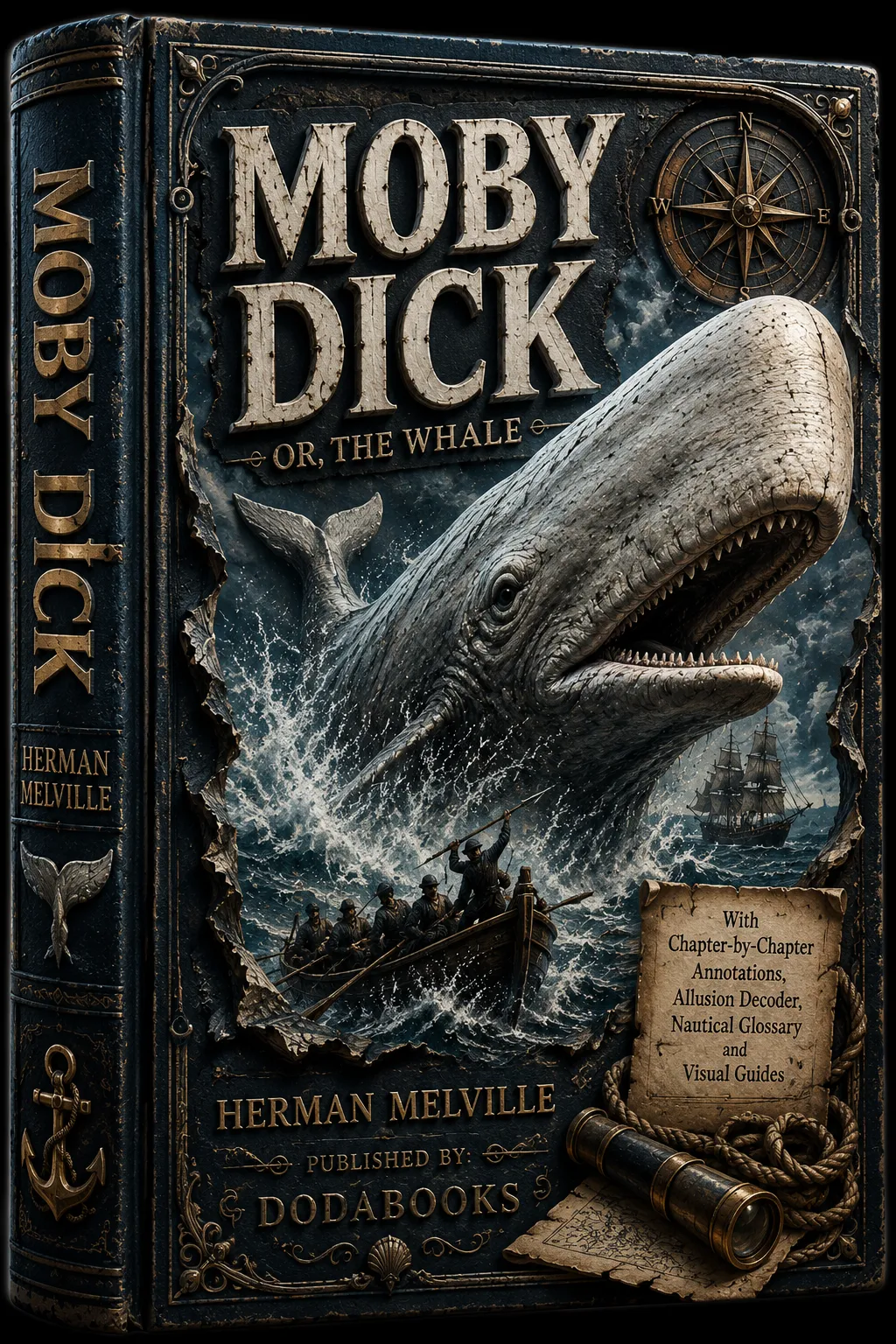
For modern readers who are less familiar with the Bible than Melville’s contemporaries, these allusions can be invisible. An annotated edition is essential for recovering this dimension of the novel. The DodaBooks annotated edition traces every biblical reference, showing how Melville used scripture to deepen his themes. Get the annotated edition →
📖 Reading the Bible in Moby-Dick
You do not need seminary training to catch the novel’s biblical layer — you need to read slowly enough to notice when Melville is quoting. Watch for three signs: names lifted straight from scripture; chapters that quietly rework a biblical scene, most obviously the sermon on Jonah; and the oceanic imagery of Job and the Psalms swelling under the action. When a passage feels larger than the plot carrying it, an allusion is usually doing the work. For the church-shaped background to the whole story, religion and fate in Moby-Dick draws these threads together — and for how the whale itself becomes a symbol, our Moby-Dick allegory guide shows the biblical frame feeding the novel’s biggest idea.
❓ Frequently Asked Questions
Is Moby-Dick a religious novel?
Not exactly. Melville uses the Bible as a framework of names, stories, and questions, but he writes from a position of lost faith rather than belief. The novel is best understood as a debate with scripture — conducted entirely in scripture’s own language.
Why does Melville name his characters from the Bible?
To load each name with immediate significance. Ahab arrives trailing the reputation of the wickedest king in Israel; Ishmael arrives as the exiled survivor; Bildad and Peleg arrive as Job’s useless comforters. One biblical name does the work of pages of character description.
What is the sermon on Jonah about, and why does it matter?
Father Mapple retells Jonah as a lesson in obedience: the prophet flees God, is swallowed, and is released only when he submits. The sermon sets up the novel’s central contrast between submission and defiance — and announces that Ahab has already chosen the wrong path.
What is the fire-worship scene in Moby-Dick?
In the storm chapter, St. Elmo’s fire burns at the mastheads and Ahab addresses the flames as a spirit, offering himself to them. Most readers take the scene as worship turned upside down — a defiant, idolatrous counterpart to the church scenes earlier in the book.
Do I need to know the Bible to understand Moby-Dick?
Not entirely — the surface story carries itself. But the biblical layer is where the novel’s depth lives, and it is almost invisible without help. That is exactly what an annotated edition restores: every allusion named, quoted, and explained as you read.
Experience Moby-Dick Like Never Before
Don’t struggle through Melville’s masterpiece alone. Our annotated edition of Moby-Dick includes:
- Complete, unabridged text of the novel
- Hundreds of explanatory footnotes clarifying obscure references
- Historical context on 19th-century whaling and Nantucket culture
- Literary analysis of key chapters and passages
- Victorian vocabulary definitions and nautical terminology
- Biblical and literary allusion guides
Get the annotated edition at DodaBooks →
📚 Related Articles
🎯 Stop Struggling. Start Understanding.
The annotated edition of Moby-Dick gives you everything you need to finally get Melville’s masterpiece:
- ✅ Complete, unabridged text — every word of the original 1851 edition
- ✅ Hundreds of explanatory footnotes — no more Googling every other page
- ✅ Historical context — the Essex disaster, Nantucket whaling, Melville’s life
- ✅ Literary analysis — chapter-by-chapter commentary on themes and symbols
- ✅ Victorian vocabulary — obsolete words and nautical terms defined inline
- ✅ Biblical & literary references — every allusion traced to its source