Review of John Huston’s 1956 film adaptation of Moby-Dick starring Gregory Peck. How does this classic hold up?
🐋
Moby-Dick (1956): Gregory Peck as Ahab — A Review
Review of John Huston's 1956 film adaptation of Moby-Dick starring Gregory Peck. How does this classic hold up?
The Classic Adaptation
John Huston’s 1956 Moby-Dick remains the definitive film adaptation of Melville’s novel, and after nearly seventy years, it still holds up with remarkable power. Shot in lush Technicolor on the actual open ocean — with real waves, real storms, real salt spray — the film possesses an authenticity that no amount of modern CGI can replicate. Huston commissioned a full-scale replica of the Pequod, built in Genoa, Italy, and the ship itself becomes a character in the film: weathered, imposing, claustrophobic in its crowded quarters, magnificent against the horizon. The production was grueling — actors endured weeks at sea, weather delays, and the constant threat of equipment damage from saltwater — but the result is a visual experience that feels genuinely dangerous, genuinely alive. Huston understood that Moby-Dick is fundamentally about the confrontation between human will and natural force, and he filmed it as a struggle between real bodies and real water, not between actors and green screens. The opening shots of the Pequod cutting through Atlantic swells remain among the most beautiful in cinema history.
Gregory Peck as Ahab
Gregory Peck was initially criticized as too wholesome, too handsome, too fundamentally decent to play Captain Ahab. Audiences and critics who knew Peck from roles like Atticus Finch in To Kill a Mockingbird — the moral center of American cinema — could not imagine him as the monomaniacal, blasphemous whaling captain who drags his crew to destruction. But the criticism missed something essential about both Melville’s character and Peck’s range. His Ahab is extraordinary precisely because he plays the role not as a raving madman but as a man possessed by terrible clarity. You watch Peck’s eyes in the quarter-deck scene, where he nails the gold doubloon and declares his vendetta, and you see intelligence burning behind the obsession. This is not a fool; this is a man who has glimpsed something about the nature of the universe that has broken his mind but not his eloquence. You understand why men would follow him to their deaths. Peck brings to the role a commanding physical presence — he fills the frame, he dominates every scene he enters — and a voice that can shift from conversational warmth to prophetic fury in a single line. His Ahab is terrifying because he is persuasive, because his vision of cosmic malice, however distorted, contains enough truth to be compelling. It is a performance that has aged magnificently, growing richer as our understanding of the novel deepens and as we recognize that Ahab’s monomania speaks to something universal in the human condition — the refusal to accept the unacceptable, the determination to impose meaning on a universe that offers none.
What the Film Gets Right
Huston and screenwriter Ray Bradbury — yes, the science fiction master was hired to write the screenplay, and his contribution is often underappreciated — wisely cut the cetology chapters, the philosophical digressions, and the encyclopedic digressions about whale anatomy that occupy hundreds of pages in the novel. What remains is the dramatic arc: Ahab’s obsession, the crew’s complicity, the escalating dread, and the catastrophic final chase. The film understands that Moby-Dick is, at its emotional core, a tragedy about a man who cannot stop, and it traces that trajectory with relentless momentum. The whale itself — realized through a combination of special effects that were state-of-the-art for 1956 and practical models — emerges as a genuine force of nature, beautiful and terrifying in equal measure. The film wisely never lets us fully see the whale until the final chase; like Melville’s novel, it understands that the white whale’s power lies partly in its mystery, its refusal to be completely known or understood. The scenes of the crew on the Pequod — the cramped quarters, the endless watches, the hierarchy of captain and mates and harpooneers — capture the daily reality of whaling life with documentary precision.
What It Leaves Out
The film’s most significant sacrifice is the philosophical depth that makes Moby-Dick a literary masterpiece rather than merely a great adventure story. Ishmael’s meditations on the meaning of whiteness, the cetological chapters that transform whale anatomy into metaphysical inquiry, the encyclopedic digressions that question the very possibility of knowledge — these cannot survive the transition to cinema without becoming either pretentious voice-over narration or incomprehensible visual abstraction. Huston made the correct choice: cut them entirely and let the dramatic action carry the film’s meaning. The result is an adaptation that is shorter, leaner, and more conventionally thrilling than the novel, but also thinner in certain fundamental ways. We lose the sense of Moby-Dick as a book that contains multitudes — that is simultaneously a whaling manual, a philosophical treatise, a literary tragedy, a comedy of manners, and a meditation on storytelling itself. The movie is an adaptation, not a transcription, and Huston knew that attempting a faithful transcription would produce something unwatchable. His Moby-Dick is a different kind of masterpiece: cinematic, visceral, and emotionally immediate in ways that the novel, for all its brilliance, sometimes sacrifices for intellectual ambition. The absence of Ishmael’s voice — that endlessly curious, self-questioning, philosophically restless narrator — is perhaps the film’s deepest loss. Without Ishmael’s interiority, we experience the story from the outside, as spectacle, rather than from the inside, as meditation. We see Ahab’s obsession but do not feel the full weight of its philosophical implications. The film gives us the drama but not the metaphysics, the action but not the ideas. This is not a criticism of Huston’s film — it is a recognition that some novels resist adaptation precisely because their power lies in modes of expression that cinema cannot replicate.
The Final Chase
The final chase sequence in Huston’s film is staged with a visceral intensity that remains deeply unsettling. Shot in real weather with real whaleboats on the open Atlantic, the scenes possess a physical immediacy that no studio-bound production could achieve. The waves are real. The spray is real. The actors’ fear as they bounce across mountainous swells in tiny wooden boats is not entirely performed. When Moby-Dick attacks — rising from the depths like a leviathan, his white bulk filling the screen — the effect is genuinely terrifying, not because of special effects but because the actors are genuinely small and genuinely vulnerable against the vastness of the ocean. The scenes of Ahab tangled in the harpoon line, dragged down by the whale with the rope coiled around his neck, are powerful and unflinching in their depiction of a man destroyed by his own instrument of destruction. Peck’s face as he is pulled overboard — a mixture of horror, defiance, and something almost like relief — is one of the great moments in screen acting. Huston understood that the final chase needed to feel not like an action sequence but like a sacrifice, a ritual destruction that has been building for the entire film. The practical whale — constructed from canvas and mechanical parts — moves through the water with a weight and presence that CGI whales never quite achieve, reminding us that cinema’s most powerful effects are often its simplest ones.
Verdict
Seventy years later, Huston’s Moby-Dick remains the best film adaptation of Melville’s novel — not because it is perfect, but because it understands the fundamental problem of adaptation itself: that direct translation from one art form to another is impossible, and that the adapter’s task is not to reproduce the source material but to create an equally valid artistic experience in the target medium. Huston’s film does not try to be Moby-Dick; it tries to be a great film inspired by Moby-Dick, and it succeeds. The performances — Peck’s commanding Ahab, Richard Basehart’s passionate Starbuck, Orson Welles’s magnificent Father Mapple — anchor the human drama with theatrical weight. The photography captures the beauty and terror of the ocean with documentary precision. The screenplay distills Melville’s sprawling narrative into a lean, propulsive thriller that never loses sight of the novel’s tragic dimensions. If you have never read Moby-Dick, Huston’s film will make you want to; if you have read it, the film will deepen your appreciation for Melville’s achievement by showing you what the story looks like when stripped to its emotional essentials. It is, in the end, the rare adaptation that honors its source by becoming something entirely its own — a testament to the power of both the novel and the cinema, and a reminder that great art can speak across mediums without losing its essential voice.
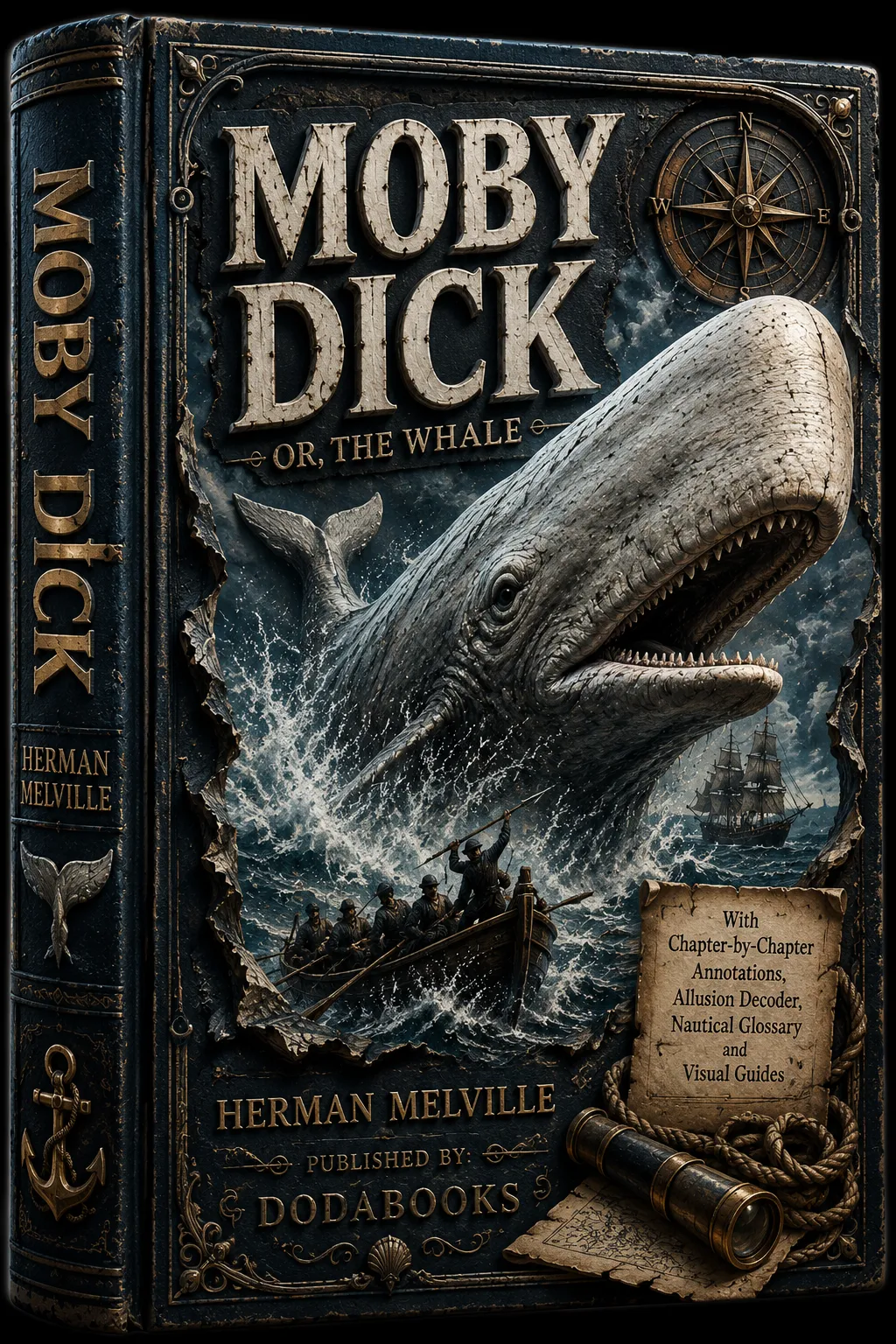
Discover the depth of Melville’s masterpiece with our annotated edition of Moby-Dick. Complete text with explanatory notes, historical context, and literary analysis.
📚 Related Articles
Frequently Asked Questions
Who directed the 1956 film adaptation of Moby Dick?
John Huston directed the 1956 adaptation, with a screenplay co-written by Huston and acclaimed sci-fi author Ray Bradbury.
How was Gregory Peck's performance as Ahab received?
While visual aesthetics and maritime realism were praised, Peck's performance was considered somewhat restrained compared to Melville's volcanic, fiery prose.
How closely does the 1956 movie follow Melville's novel?
It captures the core narrative drive and tragic ending well, though it necessarily condenses Melville's cetological chapters and philosophical monologues.
Is the 1956 film the best adaptation of Moby-Dick?
It remains the most iconic theatrical adaptation, though many literary critics note that cinema struggles to capture Melville's encyclopedic interiority.
How does reading the novel compare to watching the film?
The original novel offers unmatched philosophical depth, humor, and poetic resonance—especially when read with the comprehensive DodaBooks annotated edition.
🎯 Stop Struggling. Start Understanding.
The annotated edition of Moby-Dick gives you everything you need to finally get Melville’s masterpiece:
- ✅ Complete, unabridged text — every word of the original 1851 edition
- ✅ Hundreds of explanatory footnotes — no more Googling every other page
- ✅ Historical context — the Essex disaster, Nantucket whaling, Melville’s life
- ✅ Literary analysis — chapter-by-chapter commentary on themes and symbols
- ✅ Victorian vocabulary — obsolete words and nautical terms defined inline
- ✅ Biblical & literary references — every allusion traced to its source