Charlotte Brontë’s Jane Eyre revolutionized English literature with its fiercely independent heroine — a poor governess who refuses to compromise her principles for love, security, or status.
📖
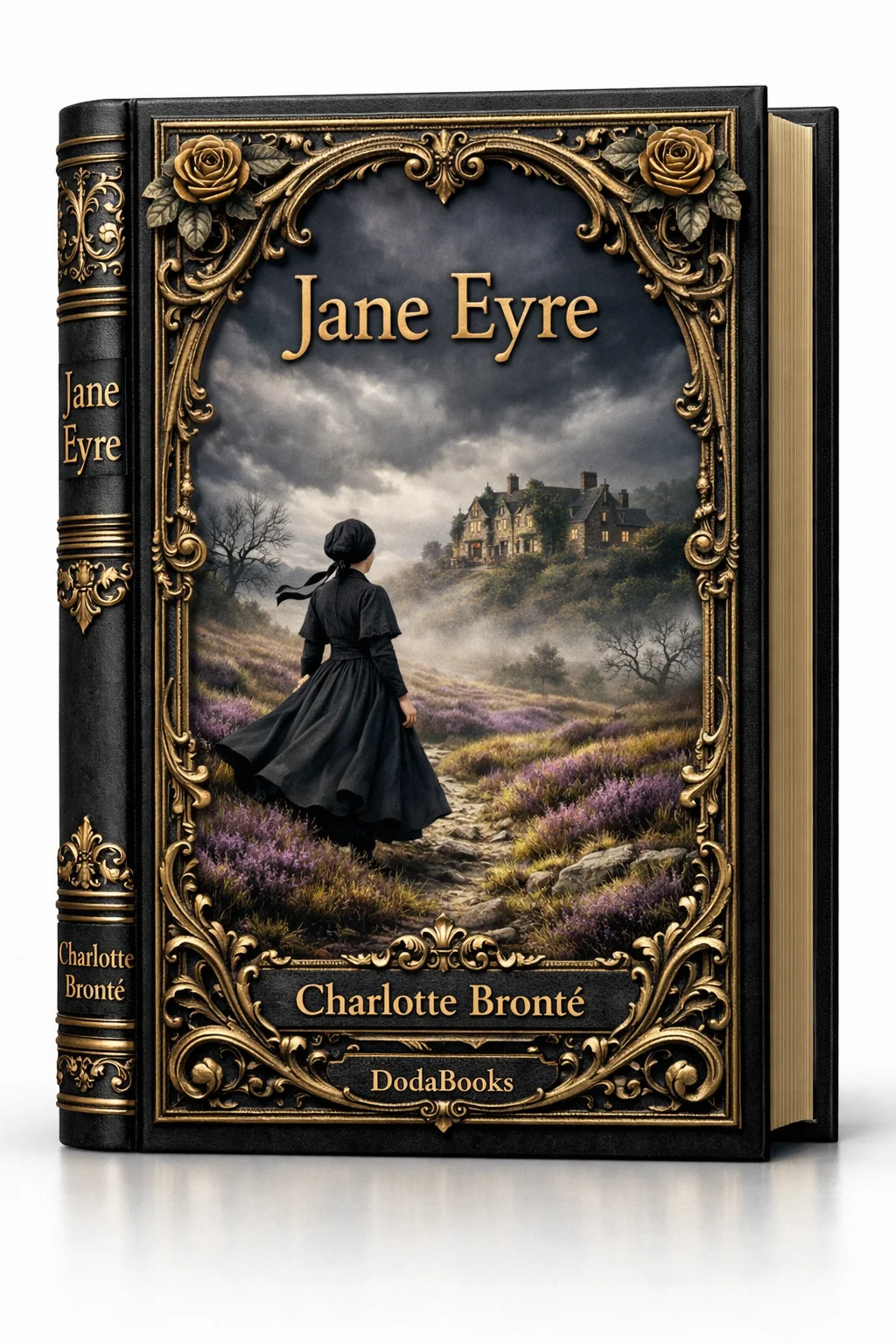
Jane Eyre
A fiercely independent governess who refuses to compromise her principles — the 1847 novel that changed English literature forever.
| Author | Charlotte Brontë (published as Currer Bell) |
| Published | 1847 |
| Genre | Gothic fiction, Bildungsroman, romance |
| Chapters | 38 |
| Setting | Early 19th-century northern England — Gateshead Hall, Lowood School, Thornfield Hall, Moor House, Ferndean |
| Legacy | A revolutionary novel for its portrayal of a passionate, principled heroine who insists on her own worth |
📖 The Story
Jane Eyre is an orphan, raised by the cruel Mrs. Reed at Gateshead Hall, then sent to the brutal Lowood School, where her friend Helen Burns teaches her endurance and her teacher Miss Temple teaches her dignity. Jane grows into a capable, independent young woman and advertises for a position as governess.
She is hired by Mrs. Fairfax to teach the French ward of Edward Rochester at Thornfield Hall. Jane and Rochester develop a deep intellectual and emotional bond. He is dark, brooding, and charismatic — she is plain, honest, and unflinching. Just as they are about to marry, a terrible secret is revealed: Rochester already has a wife, Bertha Mason, a woman driven mad and locked in Thornfield’s attic.
Jane refuses to become Rochester’s mistress and flees into the wilderness, nearly dying before being rescued by St. John Rivers and his sisters at Moor House. She discovers she has inherited a fortune from an uncle and shares it with her newfound cousins. St. John asks her to marry him and join his missionary work in India, but Jane realizes she still loves Rochester. She returns to Thornfield to find it burned to the ground by Bertha, who died in the fire. Rochester lost his sight and one hand but is alive. Jane marries him, and they live幸福 together.
🎭 Key Characters
Jane Eyre
Jane is one of literature’s most revolutionary heroines. She is poor, plain, and socially powerless — yet she refuses to be diminished by any of these things. Her famous declaration, “I am no bird; and no net ensnares me,” captures her fierce insistence on her own dignity and autonomy. She is passionate but principled, intelligent but not cold.
Edward Rochester
Rochester is the Byronic hero — handsome, brooding, passionate, and deeply flawed. He deceives Jane about his past and tries to keep her as his mistress even after his wife is revealed. Yet his love for Jane is genuine and transformative. He is humbled by fire and loss, and by the novel’s end he is a better man.
Bertha Mason
Bertha is Rochester’s first wife, a Creole woman from Jamaica who has been driven mad and locked in Thornfield’s attic. She is the novel’s most controversial figure — some critics see her as a symbol of colonial oppression, others as Jane’s dark double. Her destruction of Thornfield is both tragic and liberating.
St. John Rivers
St. John is Jane’s opposite in some ways — cold, ambitious, and driven by religious duty rather than passion. He asks Jane to marry him not from love but from practicality, seeing her as a useful missionary wife. His proposal forces Jane to recognize that a loveless life, even one of noble purpose, would be a kind of death.
Helen Burns
Helen is Jane’s friend at Lowood School — gentle, patient, and devoutly Christian. She teaches Jane the power of endurance and forgiveness. Helen dies young, and her influence shapes Jane’s moral development throughout the novel.
📖 Literary Significance
Jane Eyre was revolutionary in its portrayal of a heroine who insists on her own worth regardless of her social position. Before Brontë, heroines in love stories were typically beautiful and wealthy. Jane is neither — yet she is the most compelling woman in English fiction.
The novel pioneered the first-person female Bildungsroman. Jane narrates her own story with startling directness, telling the reader, “Reader, I married him” — a statement of agency, not submission. The novel traces her growth from abused orphan to independent woman, and every stage of that growth is earned through suffering and choice.
The Gothic elements — the mysterious Thornfield, the madwoman in the attic, the strange laughter in the walls — give the novel its atmosphere of psychological terror. But Brontë uses Gothic conventions to explore real psychological territory: the repression of female desire, the violence of class hierarchy, and the tension between passion and principle.
✨ What Makes the DodaBooks Edition Special
This is the original 1847 text, carefully prepared for modern readers without distractions or clutter.
Zero Distractions
No ads, no license pages, no project boilerplate — just the original novel, clean and uninterrupted.
Smart Typography
Curly quotes, em-dashes, proper ellipsis — typeset with care for a premium reading experience.
Chapter Navigation
Full table of contents with back-to-chapter links in every section — jump between all 38 chapters effortlessly.
Cleaned & Polished
All Gutenberg boilerplate stripped, consistent formatting throughout the text.
No DRM
You own your copy — read on any device, anytime, forever.
Instant Download
EPUB + PDF + AZW3 formats included, delivered instantly after purchase.
🏛️ Historical Context: England in 1847
Jane Eyre appeared at a transitional moment in Victorian England, and its setting matters as much as its plot. Set in the 1820s and 1830s, at a time of rapid industrialisation, it describes a world where an educated woman could — however precariously — support herself through work. Jane’s position as a governess was one of the few respectable occupations open to a respectable but impoverished woman, and Brontë, who had herself worked as a governess, knew exactly how isolating the role could be.
The novel’s Gothic machinery — the mysterious Thornfield, the strange laughter, the locked attic — reaches back to Mary Shelley’s Frankenstein and forward into the sensation fiction that would follow, giving Brontë a way to dramatise private psychological states on a mythic scale. This helps explain why 1847 readers found the book so shocking. A heroine who argues for her own worth, who rejects a marriage of convenience to a clergyman, and who refuses the role of mistress was genuinely revolutionary. If you enjoy Gothic terror and social critique, our guide to Dracula shows how the tradition Jane Eyre helped shape grew in the decades that followed.
🔥 Why Jane Eyre Still Matters
Jane Eyre has endured because its heroine asks questions that remain urgent. Is love compatible with self-respect? Must a woman choose between passion and principle? Can an individual insist on their own worth in a world determined to lower it? These are the questions of anyone who has ever felt undervalued or confined by circumstance.
The novel is also a landmark of first-person fiction. By letting Jane narrate her own story in a direct, confessional voice, Brontë created an intimacy with the reader that was unprecedented. When Jane addresses us as “Reader,” she is doing something radical: treating the reader as a confidant and insisting that her inner life is worth our full attention. Austen keeps a cooler, more ironic distance — our guide to Sense & Sensibility shows how different that narrative relationship can be.
🎓 How to Read Jane Eyre
Jane Eyre rewards two different kinds of reading. On a first pass, let the story carry you — the Gothic suspense, the forbidden romance, and the reversals of fortune are there to be enjoyed. On a second reading, pay attention to pattern: the way Jane keeps encountering adult figures who try to control her, from Mrs Reed to Brocklehurst to St John Rivers, each forcing her to define herself against them. Note also how Brontë stages the marriage question four times over, so Rochester’s proposal appears in a different moral light each time.
Its 38 chapters fall into clear phases, each with its own turning point — read the opening chapters slowly, since they establish the psychological groundwork for everything that follows. For a first-time reader deciding between Jane Eyre and Austen, our complete guide to Pride and Prejudice compares the two very different temperaments of Victorian fiction.
❓ Frequently Asked Questions
Is Jane Eyre a feminist novel?
Jane Eyre is widely considered a proto-feminist novel. Jane insists on her equality with Rochester — “I am a free human being with an independent will” — and refuses to compromise her principles for love or security. Its portrayal of a woman demanding autonomy was radical for 1847.
How long does it take to read 345 pages?
At a moderate reading pace of 30–40 pages per hour, most readers finish in 9–12 hours. The novel’s emotional intensity makes it feel faster than its page count suggests.
What is the "madwoman in the attic"?
The “madwoman in the attic” refers to Bertha Mason, Rochester’s first wife, whom he keeps locked in Thornfield’s attic. The phrase comes from Sandra Gilbert and Susan Gubar’s landmark feminist study The Madwoman in the Attic (1979), which argues that Bertha represents Jane’s repressed anger and passion.
Is it based on a true story?
No, though Brontë drew on personal experiences — her time at a harsh boarding school, her work as a governess, and her unrequited love for a married professor. The novel is fiction, but it carries the emotional truth of Brontë’s own life.
Should I read Jane Eyre or Wuthering Heights first?
They’re very different novels by different authors (Charlotte and Emily Brontë, respectively). Jane Eyre is more accessible and emotionally direct; Wuthering Heights is darker, more complex, and more structurally ambitious. If you’re new to the Brontës, start with Jane Eyre.
What happens at the end of Jane Eyre?
After Jane flees Thornfield, Rochester’s mad wife Bertha sets the house on fire and dies in the flames, leaving Rochester blinded and maimed. Jane, now an heiress who has rejected St John Rivers’s cold proposal, returns to find him humbled and changed. They marry, and Rochester’s sight partially returns once they have a child — a famously happy ending, but one earned through Jane’s refusal to compromise her principles along the way.
Why is "Reader, I married him" famous?
The line is famous because it inverts convention. Instead of an object being married off, Jane is the subject — she tells the reader, in her own direct voice, that she married Rochester. It is a statement of agency and choice after a separation that tested her resolve, and it has become one of the most quoted moments in English literature precisely because it sounds so calmly self-possessed.
📚 Related Articles
Thomas Hardy’s dramatic Cornish romance of passion and tragic misunderstanding is explored in our A Pair of Blue Eyes Guide.
📖 Read the Original Classic
Jane Eyre is one of the most beloved novels in English literature. The DodaBooks edition preserves the complete original text in a clean, distraction-free format:
- ✅ Complete 38-chapter novel — every word of the 1847 edition
- ✒️ Smart typography — curly quotes, em-dashes, proper ellipsis
- 📜 Full table of contents with chapter navigation
- 🔒 DRM-free — read on any device, anytime
- 📥 Instant download — EPUB + PDF + AZW3 formats