Is Robert Burns still worth reading today? The honest answer is yes — but with a qualification. Burns is worth reading if you approach him the right way, with the right tools, and for the right reasons.
Is Robert Burns Still Worth Reading Today?
An honest, practical answer to whether Robert Burns is still worth reading in 2026 — his timeless themes, the real language barrier, and who should (and shouldn't) read him.
👉 Get the Annotated Edition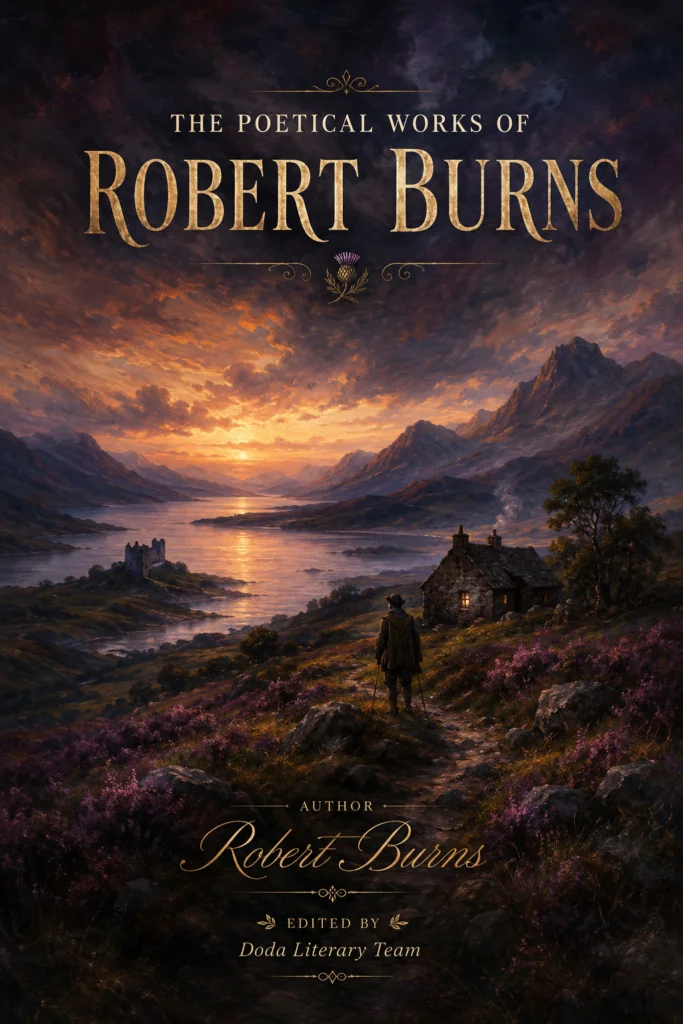
| Poet | Robert Burns (1759–1796) |
| Total Works | 539 poems and songs |
| Verdict | Worth reading with the right edition |
| Best For | Poetry lovers, students, history enthusiasts |
| Key Barrier | The Scots language |
❤️ Why He Is Worth Reading
His themes are timeless. Burns wrote about love, loss, inequality, and the struggle to live a decent life in an unfair world. Those concerns have not changed. When you read “A Man’s a Man for A’ That,” it still feels radical and relevant.
He is funny. Most people think of Burns as a “serious” poet, but he was genuinely hilarious. “Address to a Haggis” makes you laugh. “Tam o’ Shanter” is a comedy horror story. “To a Louse” is witty social commentary. Reading Burns is not a chore.
He is musical. These poems were written as songs. Reading them aloud or listening to recordings reveals a dimension that silent reading misses.
⚠️ Why He Might Not Be
The language barrier is real. If you try to read an unannotated edition, you will spend more time looking up words than enjoying poetry. This is not your fault — it is the nature of the Scots dialect.
The cultural references are obscure. Burns wrote about local people and events his original audience knew. Without footnotes, modern readers miss half the meaning.
Some poems have aged poorly. A handful of Burns’s poems rely on humour or references that land differently today. That is true of almost every writer from 250 years ago.
👤 Who Should Read Burns Today
- Poetry lovers who want to expand beyond English poets
- History enthusiasts interested in 18th-century Scottish life
- Students who want to understand a major literary figure
- Anyone curious about Scots language and culture
Who should skip him: readers who want effortless, modern language poetry. That is not a criticism — Burns requires effort. The question is whether the effort is rewarded. It is.
📚 Make Burns easy with line-by-line explanations
👉 Get the Annotated Edition🎓 What the Annotated Edition Unlocks
Line-by-Line Explanations
Every difficult line paraphrased in plain English — no more spending more time on dictionary than poetry.
500+ Scots Glossary
A complete Scots-to-English glossary cross-referenced to poem locations throughout all 539 works.
Historical Context
Learn the local people, events, and 18th-century references Burns assumed his audience would know.
Teacher's Insights
Thematic analysis and literary commentary for every stanza — understand the deeper meaning behind every poem.
Exam-Ready Format
Colour-coded formatting helps you quickly find key quotes, themes, and literary devices.
Works on All Devices
Compatible with Kindle, Apple Books, Google Play Books, Kobo, and Foliate.
🏛️ Historical & Cultural Context — the Ploughman Poet
Robert Burns was born in 1759 in Alloway, Ayrshire, the eldest son of a struggling tenant farmer. He grew up poor, was largely self-educated, and spent his teens and twenties doing hard agricultural labour while devouring whatever books he could borrow. His poetry grew directly out of that life — the thin harvests, the evictions, the loves, the local characters — and out of the Scots folk-song tradition that was still alive in the farmhouses where he worked.
When Poems, Chiefly in the Scottish Dialect was published in Kilmarnock in 1786, it sold out within weeks and made Burns famous almost overnight. Edinburgh society lionised this “heaven-taught ploughman,” as one critic called him, even while it sniffed at his manners. But Burns was never an unlettered primitive: he had read Shakespeare and the English poets closely, knew his Bible intimately, and wrote with a sharp political awareness. The 1790s, when he composed “A Man’s a Man for A’ That,” were a genuinely frightening decade for anyone who praised liberty — Britain was at war with revolutionary France, and critics of the establishment were prosecuted. Declaring that “the rank is but the guinea’s stamp” was a pointedly radical claim when it was written, and understanding that makes the poem far more powerful. It’s worth remembering that the real barrier to enjoying Burns is mostly language, not ideas.
In his final years Burns devoted himself to something priceless: he collected, edited, and shaped hundreds of old Scots folk songs for James Johnson’s Scots Musical Museum and George Thomson’s Select Collection, saving many songs from extinction. That conservation work, as much as his own poems, is why Scotland calls him its national bard. For the full story of his short, dramatic life, our Robert Burns guide traces it in detail.
📜 Why He Still Matters — Evidence, Not Nostalgia
You can measure Burns’s reach without resorting to sentiment. John Steinbeck took the title Of Mice and Men from a line in “To a Mouse,” and that title is still taught in almost every English-speaking classroom. Bob Dylan has repeatedly named Burns as one of the songwriters who influenced him most. “Auld Lang Syne” is sung at New Year in Scotland, in Japan, in Times Square — a Burns song turned into a global ritual. And every January 25, Burns Night suppers take place on every continent, with haggis piped in and the “Address to a Haggis” read aloud in Scots to audiences who often cannot translate half of it but cheer along anyway.
That last detail is the real evidence. A poet gets a worldwide annual celebration only when people feel the poems belong to them. Burns wrote about being broke, being in love, being ill-used, being mortal — and he wrote in a voice that treats the reader as an equal, not as a subject for improvement. The egalitarian instinct running through the whole body of work is why each generation keeps finding him: the questions he asks — about worth, about inequality, about how ordinary people survive an unfair world — are the questions a modern reader is already asking.
📖 How to Read Burns in 2026 — A Practical Plan
Start where the language is easiest. “A Red, Red Rose,” “John Anderson, my Jo,” and “Ae Fond Kiss” sit close enough to modern English that a first-time reader can feel the music without a dictionary. Reading a handful of poems with side-by-side translations warms the ear to Scots quickly. From there, move to the masterpieces that look harder than they are: Tam o’ Shanter is a wild folk-tale of witches and a runaway mare that reads like a superb ghost story, and To a Mouse is the compassionate meditation that earned Burns a poem named after it a century and a half later.
Then read aloud. These poems were written to be heard, and even a hesitant spoken reading reveals a rhythm that silent reading flattens. Keep a glossary — or the annotated edition’s line-by-line notes — beside you so you never stop on a word. When you meet a difficult stanza, read the original once, check the plain-English paraphrase, then read it aloud again. The meaning clicks into the music, and the poem starts working the way Burns intended.
✍️ The Bottom Line
So, is Robert Burns still worth reading today? Yes — not as a dusty duty, but as a living pleasure. His jokes still land, his love songs still ache, his fury at injustice still feels current, and now that the language barrier is genuinely solvable, there is no good reason to leave him on the shelf. Burns asks for a little patience at the start and returns it with more delight than almost any other poet in the language.
❓ Frequently Asked Questions
Is Burns harder to read than Shakespeare?
In different ways. Shakespeare writes in Early Modern English, which is closer to modern English than Scots. Burns uses a distinct language with different vocabulary — ken (know), gang (go), bonnie (beautiful) — that requires its own glossary.
What makes Burns relevant in 2026?
His themes of equality, social justice, and authentic human connection feel more urgent than ever. “A Man’s a Man for A’ That” resonates in an age of widening inequality.
Can I enjoy Burns without a glossary?
You can get maybe 60% of the meaning. The remaining 40% requires either prior knowledge of Scots or an annotated edition with translations.
Which Burns poem should a beginner read first?
“A Red, Red Rose” — it’s short, mostly modern English, and shows Burns at his most beautiful and accessible.
How long does it take to read all of Burns's poems?
Reading all 539 poems straight through would take 20–30 hours. Most readers focus on the 20–30 most famous works, which takes 3–5 hours with annotations.
Is the free public domain version good enough?
For “Auld Lang Syne” at New Year, yes. But for understanding poems like “To a Mouse” or “Tam o’ Shanter,” the annotations are worth the investment.
Why is Burns called Scotland's national poet?
He captured and preserved the Scots language, collected hundreds of folk songs that might otherwise have been lost, and his poems speak for ordinary Scottish life. The annual Burns Night celebrations and “Auld Lang Syne” at New Year keep that status active today rather than merely historical.
Which famous works did Burns inspire?
John Steinbeck took the title of Of Mice and Men from “To a Mouse,” Bob Dylan has repeatedly named Burns as a defining influence, and “Auld Lang Syne” is sung worldwide every New Year — a Burns song that has outlived almost everything written in its decade.
Should I read Burns's poems in the order he wrote them?
No. Start with the accessible love songs, then move to the famous narrative poems, then explore by theme. Chronological order matters more for scholars than for readers meeting Burns for the first time.
📚 Related Articles
Ready to discover why Burns still matters?
Poems and Songs of Robert Burns — The Annotated Edition
All 539 poems with line-by-line explanations, 500+ Scots glossary entries, and Teacher’s Insights — for less than the price of a coffee.
👉 Get the Annotated Edition{ .cta-button }