Herman Melville wrote more than Moby-Dick. Discover his other major works, from Typee to Billy Budd.
🐋
Herman Melville's Other Books: Beyond Moby-Dick
Herman Melville wrote more than Moby-Dick. Discover his other major works, from Typee to Billy Budd.
Early Successes
Before Moby-Dick, Melville was a popular writer of adventure narratives. Typee (1846) told of his time among the Typee people in the Marquesas Islands. It was a huge success, praised for its vivid descriptions of island life and its critique of Western colonialism. The book made Melville famous overnight — here was a young American who had actually lived among “savages” and returned to write about it. Readers loved the exoticism, the danger, the sense of a world beyond their experience.
Omoo (1847) continued the story, following the narrator’s adventures among the islanders and the whaling ships of the Pacific. Together, Typee and Omoo established Melville as the voice of the South Seas — a brand that would prove both profitable and limiting. Readers wanted more adventure, more exoticism, more tales of life among the islanders. Melville, restless and ambitious, wanted to write something deeper.
Redburn (1849) and White-Jacket (1850) were based on later voyages, and they show Melville’s growing sophistication as a writer. Redburn is a coming-of-age story about a young man’s first voyage at sea, and it contains some of Melville’s finest prose. White-Jacket is a satirical account of life aboard a man-of-war, and it anticipates many of the themes that would reach their full expression in Moby-Dick: the cruelty of naval discipline, the hierarchy of power at sea, the relationship between individual freedom and institutional authority.
These early works are not merely juvenilia — they are accomplished novels that deserve readers in their own right. They show Melville developing his craft, testing his range, and building toward the masterpiece that would both make and destroy his career.
After Moby-Dick: The Decline
📖 Want the complete annotated experience?
👉 Get the Annotated EditionThe failure of Moby-Dick affected Melville deeply. He had poured his soul into the novel, and the world’s indifference was devastating. Pierre (1852) was a psychological melodrama that baffled readers who expected another sea adventure. The novel tells the story of a young man who discovers a terrible secret about his mother and descends into madness. It was savaged by critics — one headline read “HERMAN MELVILLE CRAZY” — and it effectively ended Melville’s career as a popular novelist.
The Confidence-Man (1857) was a dark satire set aboard a Mississippi steamboat, and it was his last published novel. The book is a series of encounters with various confidence men, each representing a different form of deception. It is brilliant, maddening, and nearly impenetrable — a novel that seems deliberately designed to alienate readers. By this point, Melville had stopped writing for the public and started writing for himself.
The years between Moby-Dick and Billy Budd were years of quiet desperation. Melville worked as a customs inspector in New York, wrote poetry that almost no one read, and watched his reputation fade into obscurity. By the time of his death in 1891, he was virtually unknown — a footnote in American literary history. It was not until the 1920s that scholars rediscovered his work and recognized its genius.
Bartleby, the Scrivener
Melville’s shorter fiction includes some of his finest work. “Bartleby, the Scrivener” (1853) is the story of a Wall Street copyist who “prefers not to” do his work — a haunting tale about alienation and capitalism that has become one of the most discussed short stories in American literature. The phrase “I would prefer not to” has entered the cultural lexicon as a expression of quiet resistance, passive noncompliance, and the refusal to participate in systems that demand conformity.
What makes Bartleby so powerful is its ambiguity. Is Bartleby a proto-existentialist hero, refusing to participate in a meaningless system? Is he mentally ill, driven mad by the conditions of his work? Is he dead already, a ghost haunting the offices of a Wall Street lawyer? Melville refuses to answer these questions, and the refusal is the story’s genius. Bartleby remains one of literature’s great enigmas — a character who resists interpretation the way he resists authority.
The story is also a devastating critique of capitalism. The lawyer who narrates the story is not a villain — he is a reasonable, decent man who tries to accommodate Bartleby’s increasingly strange behavior. But the system he represents is incapable of accommodating difference. Bartleby’s refusal to work is not just a personal choice — it is a rejection of the entire value system that the lawyer’s office embodies. The story asks: what happens when a human being refuses to be a productive member of society? The answer, Melville suggests, is destruction — both of the individual and of the system that cannot tolerate him.
Billy Budd
His final work, discovered among his papers after his death and published in 1924, has become a classic. Billy Budd, Foretopman is the story of a handsome young sailor whose innocence destroys him — or rather, whose innocence is destroyed by the evil of others. Billy is beautiful, good, and incapable of understanding malice. When he is falsely accused of mutiny by the master-at-arms, Claggart, he strikes Claggart in a moment of confused rage. Claggart dies. Captain Vere, recognizing Billy’s innocence but bound by the laws of war, sentences him to hang.
The novel is a meditation on the relationship between good and evil, innocence and experience, law and justice. Billy is not just a character — he is an archetype, the innocent whose goodness is so pure that it threatens the established order. Claggart is his opposite — a figure of pure malice, motivated by envy and hatred. Captain Vere is the tragic middle ground, a man who recognizes good and evil but must choose the law over justice.
The novel’s final words — “Billy Budd, Foretopman” — have haunted readers for a century. They suggest both a name and a statement of identity: this is who Billy was, and this is what the world did to him. The novel is one of the great tragedies of American literature, and it is all the more powerful for being Melville’s last word.
Poetry
Melville’s poetry was neglected during his lifetime but has gained recognition. Battle-Pieces (1866) is one of the first great collections of Civil War poetry, written by a man who witnessed the war from the streets of New York and who understood its moral complexity. The poems are not glorifications of war — they are meditations on sacrifice, loss, and the terrible cost of conflict.
Melville later published Clarel (1876), a 180-line poem about an American divinity student traveling in the Holy Land. It is one of the longest poems in American literature, and it is largely unread — but those who have read it consider it a masterpiece of philosophical poetry. The poem grapples with faith, doubt, and the search for meaning in a world that seems indifferent to human aspiration.
The poetry is essential to understanding Melville’s full range as a writer. He was not just a novelist — he was a poet of extraordinary ambition and power, and his verse deserves the same attention as his prose.
The Complete Melville
Readers who love Moby-Dick should explore Bartleby, Billy Budd, and Typee. Melville is not a one-book author. His body of work spans maritime adventure, bitter social satire, existential philosophy, and profound narrative poetry, rewarding every reader willing to explore beyond the masterwork.
The tragedy of Melville’s career was the mismatch between his artistic evolution and Victorian commercial expectations. After the explosive popularity of Typee and Omoo, 19th-century readers demanded colorful Polynesian escapism. When Melville pivoted toward metaphysical profundity in Moby-Dick and dark psychological ambiguity in Pierre, the literary marketplace abandoned him. For nineteen years, from 1866 to 1885, America’s greatest prose visionary worked quietly as a district customs inspector on the New York docks, paying for his poetry publications out of his own modest savings.
Yet this long period of public neglect gave Melville absolute intellectual freedom. Unburdened by the need to flatter commercial audiences, he produced works of uncompromising honesty: the devastating alienation of Bartleby, the Scrivener, the piercing skepticism of The Confidence-Man, the epic spiritual inquiry of Clarel, and the transcendent moral tragedy of Billy Budd, Sailor.
The best approach is to start with Moby-Dick, then work outward — to Bartleby for the shorter fiction, to Typee for the early adventures, to Billy Budd for the final testament. Each work illuminates the others, and together they reveal an American literary titan of astonishing range, courage, and timeless modern relevance.
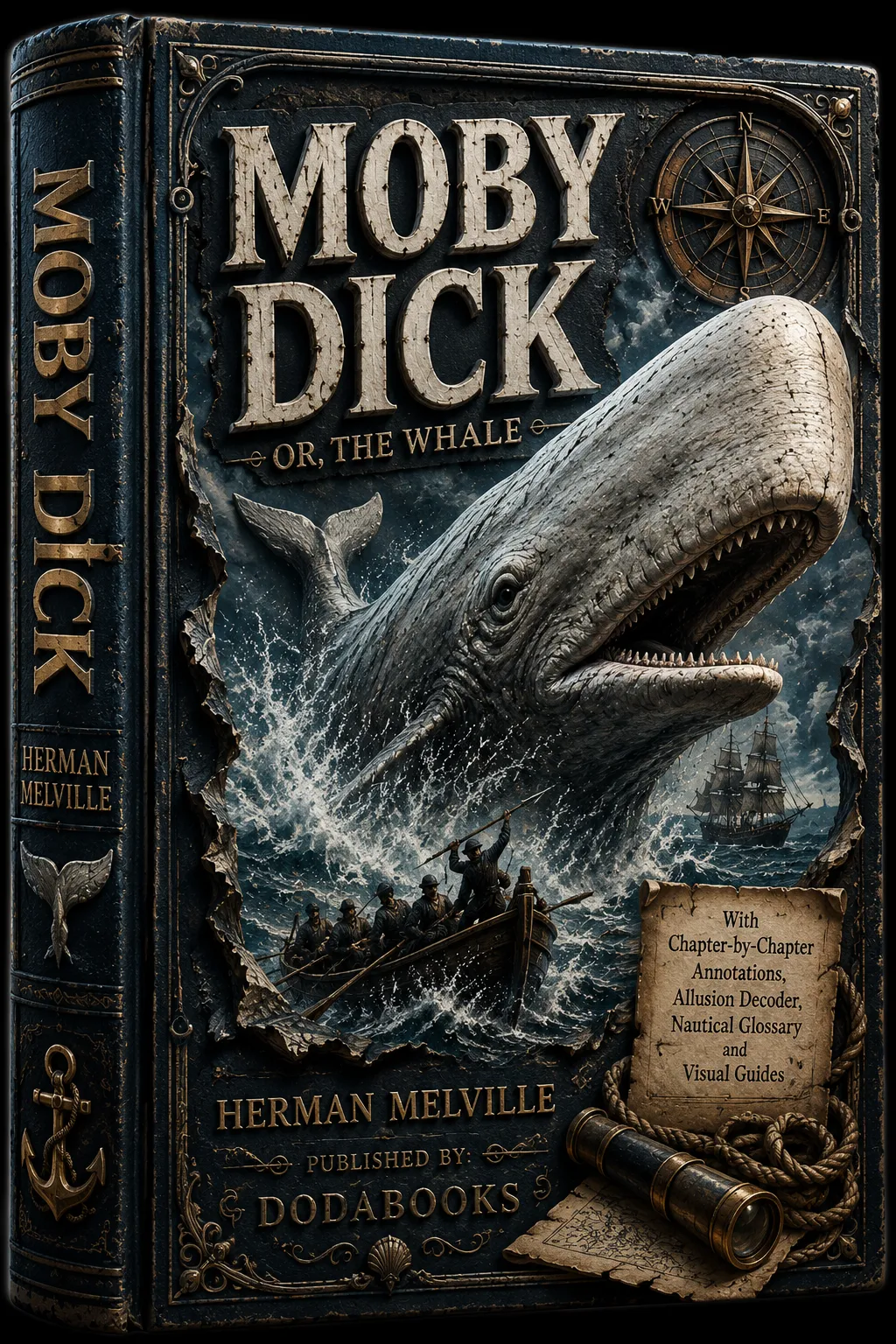
Discover the depth of Melville’s masterpiece with our annotated edition of Moby-Dick. Complete text with explanatory notes, historical context, and literary analysis.
📚 Related Articles
Frequently Asked Questions
What was Herman Melville's most popular book during his lifetime?
Typee (1846), a semi-autobiographical Polynesian adventure, was Melville's biggest commercial success while he was alive.
What is Billy Budd, Sailor about?
Billy Budd is a tragic novella exploring innocence, duty, and martial law aboard an 18th-century British naval ship, published posthumously in 1924.
Why did Melville's later books like Pierre fail commercially?
Pierre was rejected for its scandalous psychological themes, incestuous undertones, and experimental melodrama, alienating contemporary Victorian audiences.
Did Herman Melville write poetry?
Yes, Melville spent the last three decades of his life writing poetry, including Battle-Pieces on the Civil War and the 18,000-line epic Clarel.
Where can I find carefully curated, annotated classic literature?
DodaBooks publishes masterfully annotated editions of maritime, Victorian, and philosophical classics with enhanced typography and detailed footnotes.
🎯 Stop Struggling. Start Understanding.
The annotated edition of Moby-Dick gives you everything you need to finally get Melville’s masterpiece:
- ✅ Complete, unabridged text — every word of the original 1851 edition
- ✅ Hundreds of explanatory footnotes — no more Googling every other page
- ✅ Historical context — the Essex disaster, Nantucket whaling, Melville’s life
- ✅ Literary analysis — chapter-by-chapter commentary on themes and symbols
- ✅ Victorian vocabulary — obsolete words and nautical terms defined inline
- ✅ Biblical & literary references — every allusion traced to its source