What does “From hell’s heart I stab at thee; for hate’s sake I spit my last breath at thee” mean? Analysis of Captain Ahab’s climactic final speech in Herman Melville’s Moby-Dick, exploring Ahab’s unyielding defiance, the symbolism of his doom, and its famous legacy from literature to Star Trek.
🐋
From Hell's Heart I Stab at Thee: Ahab's Last Words in Moby-Dick
Analysis of Ahab's final speech in Moby-Dick. 'From hell's heart I stab at thee' is one of literature's most powerful dy...
The Context
Ahab’s final speech in Moby-Dick comes during the third day of the chase. The Pequod is sinking. The whale is approaching. Ahab knows he is about to die. His response is not fear but defiance.
To understand the power of these words, you must understand where Ahab stands at this moment. He has chased the white whale across three oceans. He has lost his leg, his ship, his crew. His first mate, Starbuck, has begged him to turn back. His prophecy-bearing harpooneer, Fedallah, has been killed and draped over the whale’s back. Everything Ahab has sacrificed — his family, his reason, his humanity — has led to this single, annihilating moment. The whale is here. The end is here. And Ahab chooses, in his final seconds, not mercy, not regret, but war.
This is what makes Ahab one of literature’s most terrifying figures. He is not deluded. He knows the whale will destroy him. He knows the Pequod is lost. He knows his crew will die. And he sails forward anyway — not because he believes he can win, but because he cannot imagine surrender. The speech is not the cry of a man who thinks he will triumph. It is the war cry of a man who refuses to stop fighting, even when the fight is already lost.
The Full Speech
📖 Want the complete annotated experience?
👉 Get the Annotated Edition“Towards thee I roll, thou all-destroying but unconquering whale; to the last I grapple with thee; from hell’s heart I stab at thee; for hate’s sake I spit my last breath at thee.”
The speech is six sentences compressed into one. Each clause escalates the intensity. The language moves from physical motion (“Towards thee I roll”) to spiritual warfare (“from hell’s heart”), from struggle (“I grapple”) to pure venom (“for hate’s sake”). By the final phrase, Ahab has transcended mere anger. He has become something beyond human — a force of pure opposition, a man whose entire existence has been reduced to a single act of defiance.
Line by Line
“Towards thee I roll” — Ahab is already in motion toward the whale. The verb “roll” is strange and powerful. Ahab is not walking, running, or charging. He is rolling — as if the sea itself has taken hold of him, as if his movement is no longer entirely his own. The whale has become his gravity.
“thou all-destroying but unconquering whale” — The whale has destroyed everything, yet remains “unconquering.” It has never sought conquest. It simply exists. This is the cruelest irony of Ahab’s obsession: he is waging war against something that has no intention of fighting back. The whale does not hate Ahab. The whale does not know Ahab exists. The whale is simply a whale — vast, indifferent, and utterly beyond human meaning.
“to the last I grapple with thee” — Ahab will fight until his final breath. The word “grapple” evokes both physical combat and the act of holding on — of refusing to let go, even when what you are holding will pull you under. Ahab is not just fighting the whale. He is clinging to his obsession, and the obsession is dragging him into the abyss.
“from hell’s heart I stab at thee” — The hatred comes from the deepest part of him. Not from anger, not from grief, but from something beyond damnation. The image of “hell’s heart” suggests a love so corrupted it has become its own opposite. Ahab’s hatred for the whale is a dark mirror of devotion — absolute, all-consuming, and ultimately self-destructive.
“for hate’s sake I spit my last breath at thee” — Hatred for its own sake. Pure, unredeemed defiance. The final clause strips away all pretense. Ahab is not fighting for justice, or revenge, or glory. He is fighting because fighting is all he has left. The act of opposition has become his identity. Without the whale to rage against, Ahab would not know who he is.
The Significance
Ahab does not repent. He does not bargain or pray. He dies exactly as he lived: defiant, angry, and utterly committed. This is the tragedy of Ahab — not that he fails, but that he cannot imagine any other way to be.
In Christian theology, the dying moment is an opportunity for grace. The good thief on the cross beside Jesus is promised paradise because he repents in his final breath. Ahab is the anti-thief. He uses his final breath not to surrender but to curse. There is no grace in Ahab’s death, no redemption, no peace. There is only the Howl — the primal scream of a man who has chosen hatred over love, defiance over submission, the abyss over the light.
This is what makes Ahab a genuinely tragic figure, rather than merely a villain. He is not evil in the way that Iago or Richard III are evil. He is destroyed by something he cannot control — his own obsessive nature, his refusal to accept the limits of human power. He is a Promethean figure, chained to his own defiance, punished not for hubris alone but for the inability to be anything other than what he is.
Dramatic Echoes
The speech echoes the intensity of classic tragedy — Lear on the heath, Macbeth facing his end — but Melville achieves this effect in prose, not verse.
The echoes run deeper than mere style. King Lear, raging against the storm, cries: “Blow, winds, and crack your cheeks! Rage, blow!” The language is similar — apostrophe, defiance, the human voice raised against the elements. Macbeth, upon hearing of Lady Macbeth’s death, delivers his famous “Tomorrow and tomorrow and tomorrow” speech, concluding that life is “a tale told by an idiot, full of sound and fury, signifying nothing.” Ahab’s final words share this nihilistic energy — the sense that all human striving is ultimately meaningless.
But Melville’s vision is darker. Lear and Macbeth at least recognize the futility of their rage. Ahab does not. He goes to his death still believing — or pretending to believe — that his struggle matters, that the whale can be defied, that hatred is a meaningful response to the indifference of the universe. This makes Ahab more terrifying than any traditional villain. He is rage without reflection, defiance without self-awareness, a man who has become his own obsession so completely that he cannot see that the obsession has consumed him.
The Cultural Afterlife
“From hell’s heart I stab at thee” has transcended its literary origins. It has been quoted in films, referenced in television shows, borrowed by musicians, and adapted by countless writers. The line has become shorthand for defiance in the face of destruction — a verbal clenched fist raised against fate itself.
The phrase’s power lies in its universality. Everyone has felt the impulse to rage against something larger than themselves — a fate, a system, a force that seems determined to crush them. Ahab gives that impulse its most eloquent expression. He says what most of us only think: that sometimes the only response to an unjust universe is to spit in its face.
But the line also carries a warning. Ahab’s defiance is not heroic. It is self-destructive. His rage does not defeat the whale. It destroys the Pequod, kills the crew, and leaves Ahab himself tangled in his own harpoon line, dragged into the depths. The cultural celebration of Ahab’s defiance often overlooks this consequence. To quote “from hell’s heart I stab at thee” as a rallying cry is to forget that the speaker is a man who has lost everything — including himself.
Discover the depth of Melville’s masterpiece with our annotated edition of Moby-Dick. Complete text with explanatory notes, historical context, and literary analysis.
📚 Related Articles
Frequently Asked Questions
What are Captain Ahab's famous final words?
Ahab screams: 'From hell's heart I stab at thee; for hate's sake I spit my last breath at thee!' before being dragged under by his own harpoon line.
Where did the line 'From hell's heart I stab at thee' originate?
It originated in Chapter 135 of Herman Melville's Moby-Dick and was later popularized in modern pop culture, notably by Khan in Star Trek II.
What do Ahab's final words reveal about his psychological state?
They reveal total defiance against mortality and cosmic order; even facing inevitable destruction, Ahab refuses repentance or surrender.
How does Ahab die in Moby-Dick?
A flying turn of the fouled harpoon line catches him around the neck, snapping him out of the whaleboat and into the depths of the Pacific.
What edition best explains the symbolism of the final chase scene?
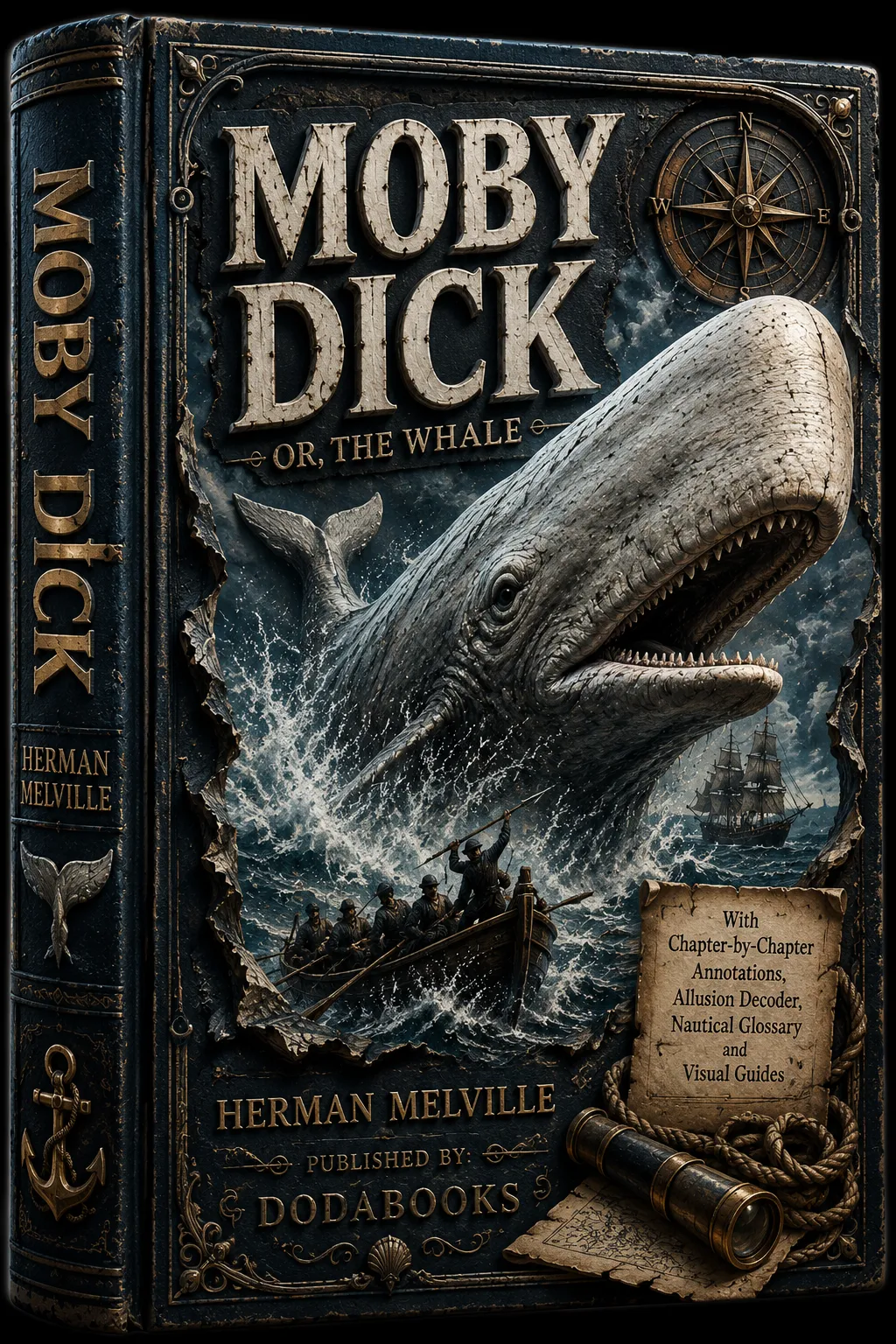
The DodaBooks annotated edition breaks down nautical seamanship, allegorical motifs, and poetic structure throughout the epic three-day chase.
🎯 Stop Struggling. Start Understanding.
The annotated edition of Moby-Dick gives you everything you need to finally get Melville’s masterpiece:
- ✅ Complete, unabridged text — every word of the original 1851 edition
- ✅ Hundreds of explanatory footnotes — no more Googling every other page
- ✅ Historical context — the Essex disaster, Nantucket whaling, Melville’s life
- ✅ Literary analysis — chapter-by-chapter commentary on themes and symbols
- ✅ Victorian vocabulary — obsolete words and nautical terms defined inline
- ✅ Biblical & literary references — every allusion traced to its source