Teaching your first Pride and Prejudice unit as a new teacher is intimidating — you are still figuring out classroom management, lesson pacing, and assessment, and now you need to teach a 200-year-old novel. Here is how to survive and actually enjoy the unit.
A First-Year Teacher's Guide to Teaching Pride and Prejudice
Everything a first-year teacher needs to survive their first Pride and Prejudice unit — pacing, lesson planning, classroom management tips, and ready-to-use resources that reduce prep stress.
| Challenge 1 | You don’t know how long things take |
| Challenge 2 | You don’t know what students find confusing |
| Challenge 3 | You don’t have backup materials |
| Solution | Complete novel study unit with timing guidance |
| Best For | First-year high school ELA teachers |
🧭 What This Unit Is — and Isn’t
A usable Pride and Prejudice unit is not a stack of worksheets. It is a teaching system: a schedule that fits your calendar, materials that already have answers, and activities designed to survive contact with a real classroom. That is the difference this guide is built on. Instead of throwing resources at you, it hands you a spine — pre-reading, guided reading, checks for understanding, and assessment — with enough backup material that nothing catches you flat-footed.
The unit assumes you are starting from zero. It does not require you to have taught the novel before or to know every Regency detail from memory. The context sheets, chapter summaries, and answer keys exist precisely so that the first time you teach this novel is not also the first time you have to design it. If you already have a broader plan for the year, you can borrow the structure from our step-by-step guide to planning a Pride and Prejudice unit and use this unit to fill the gaps rather than replace everything.
And yes — every chapter is covered. All 61 chapters are summarised, so when a student asks what happened in Chapter 34 (the disastrous first proposal), you can answer without stalling the discussion.
🎒 The First-Year Teacher’s Problem
New teachers face three challenges that veteran teachers have solved through experience:
- You do not know how long things take. You plan three activities for one class period and finish in 15 minutes with nothing left.
- You do not know what students will find confusing. You assume the entailment plot is clear — it is not. You assume students understand irony — many do not.
- You do not have backup materials. When a lesson finishes early or a discussion falls flat, you have nothing to fill the gap.
A complete novel study unit solves all three problems by providing more materials than you need, with clear timing guidance.
✅ Before You Start: What to Do in Week 1
Read the unit cover to cover. As a new teacher, you cannot afford to discover a resource exists while standing in front of 30 students. Flip through the entire PDF. Know what is in the pre-reading section, where the quizzes are, and how the answer key is organised.
Make the pacing guide your skeleton. The unit includes 4-week, 6-week, and 8-week pacing guides. Pick the one that matches your school calendar and stick to it. The guide tells you exactly which chapters to cover each day and which resources to use.
Print everything before the unit starts. Printing one section the night before works for veterans. As a first-year teacher, the copier will jam on the day you need it. Print all student-facing materials in advance and organise them by section.
⭐ The 5 Sections You Cannot Skip
1. The anticipation guide (pre-reading). Students debate statements like “First impressions are usually correct.” This takes 20 minutes, requires no prior knowledge, and hooks students immediately.
2. The Regency context handout. Give students the two-page context sheet before Chapter 1. Without understanding entailment, class structure, and women’s legal status, the novel makes no sense.
3. The character family tree. Print the character tree and the 10-character table. Students will refer to it constantly. Laminate a class set if you can.
4. The section quizzes. Give the short quiz at the end of each section. These confirm students are reading and give you data on who is struggling. Grading takes 15 minutes with answer keys.
5. The essay rubric. Before students write their first essay, go over the rubric together. Show them what “Exemplary” looks like versus “Developing.”
🏛️ Teach the World Before the Words
Students bounce off Jane Austen far more often for missing context than for difficult vocabulary. Pride and Prejudice assumes its reader already understands that an entail sends the family estate to Mr. Collins instead of the Bennet daughters, that a woman’s income and marriageability were tightly linked, and that calling cards and visiting were a working social system, not cosplay. Without that frame, the plot looks like a series of arbitrary misunderstandings.
That is why the Regency context handout should come before Chapter 1, not after it. Cover the basics in twenty minutes: the entail, inheritance law, marriage settlements, class and income, and the etiquette of calling. Run one anticipation-guide statement — “A woman’s first duty is to marry well” — before the context, so students take a position first and watch it shift as they learn the rules. If you want a set of ready-made prompts for the pre-reading phase, the free classroom discussion questions slot straight into that week.
Designed with first-year teachers in mind. The Pride and Prejudice Novel Study Unit includes everything from pacing guides to participation trackers.
📚 Pacing Guides
4-week, 6-week, and 8-week schedules — pick one and follow it day by day.
📖 Chapter Summaries
All 61 chapters for previewing or when students didn't do the reading.
❓ Discussion Questions
72 questions with model answers — know exactly what a good response looks like.
📝 Quizzes with Keys
20+ assessments with complete answer keys — grade a class set in 15 minutes.
✍️ Essay Rubric
4-criteria rubric with clear descriptors — no more subjective grading uncertainty.
🎯 Backup Activities
Close reading passages, deeper dive prompts, and creative projects for extra time.
⏱️ Pacing, Grading, and the Pitfalls That Sink First-Year Units
Pacing. Trust the pacing guide, but build slack into week one. New teachers habitually assign too much reading too fast — Pride and Prejudice’s chapters are short and deceptive, and “two chapters by Thursday” quietly becomes four chapters nobody finished. A reliable rhythm is: open each class with a five-minute recap of the previous reading (the chapter summaries make this painless), read one key passage aloud together, then spend the rest of the period on the discussion questions. Reserve essay work for the end of each volume.
Grading. Protect your evenings. The section quizzes take about fifteen minutes to grade with the answer keys, and you should not be grading every discussion on paper. Use the Socratic seminar observation form to score participation live, while the discussion actually happens, so you walk out with assessment data already collected. For essays, attach the rubric to the prompt before students begin — a rubric you show in advance is a teaching tool, and a rubric you reveal after marking is a grievance.
Pitfalls. Three mistakes sink more first-year units than any other. First, skipping the entail explanation — without it the central stakes of the novel are invisible. Second, assuming students hear Austen’s irony; most read the narration straight, so teach free indirect discourse explicitly (“is Austen agreeing with her character, or gently mocking her?”). Third, front-loading thesis-level analysis before students know what even happened. Sequence it: make sure they can reconstruct the events, then argue about what they mean. If you are unsure how hard to push your particular group, our differentiation guide for struggling and gifted students works through both ends of the spectrum.
💡 Why This Unit Exists
Teaching Pride and Prejudice in year one is hard because the novel asks a lot of its teacher: tight pacing, an eye for irony, and Regency context summoned on demand. The unit supplies all three. Every discussion question has a model answer, so you know what “good” looks like before you ask. Every quiz has a key, so grading is a task rather than a puzzle. Every lesson has a backup activity, so a period that finishes fifteen minutes early becomes an opportunity instead of an emergency.
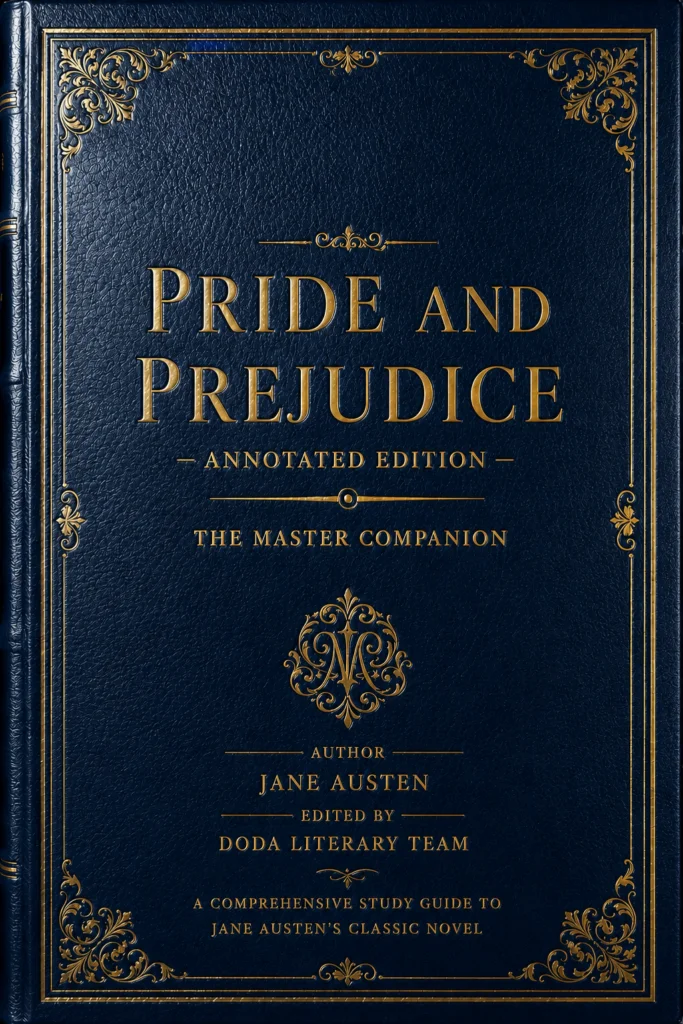
The genuinely distinctive piece is the pairing with the annotated edition itself. The unit gives you the classroom machinery; the annotated novel gives students the same passages explained at chapter level, with Regency vocabulary and cultural notes placed where they hit them. Struggling readers can lean on the notes without feeling singled out, and advanced students can push past them into the deeper-dive prompts. For help deciding how to weigh your assessments, the quiz, essay, and test comparison matches each format to the skills you actually want to grade.
❓ Frequently Asked Questions
I'm worried about classroom management during discussions. How do I keep students on task?
Use the participation tracker from the teacher toolkit. Tell students you are tracking who contributes. The Socratic seminar observation form lets you assess quietly while students lead discussion.
What if the discussion dies after 5 minutes?
Pull out the deeper dive prompt from the section. Or switch to a write-pair-share — students write for 2 minutes, share with a partner for 2 minutes, then debrief as a class.
What if students didn't do the reading?
Use the chapter summary as a read-aloud. Read it together in 5 minutes, then proceed with discussion questions based on the summary alone.
What if a student asks a question I can't answer?
Be honest. Say "That is a great question — I want to think about it." Then check the answer key or literary analysis section before the next class.
What if I finish a lesson with 15 minutes remaining?
Keep the close reading passages in your back pocket. Pick one paragraph and have students annotate it individually, then discuss as a class.
How many weeks should the unit take?
Use the pacing guide that fits your calendar — 4-week, 6-week, and 8-week versions are included. Most first-year teachers running 45–50 minute periods find the 6-week version the most comfortable fit.
How do I grade participation fairly?
Use the participation tracker and the Socratic seminar observation form. Score contributions live during discussion against the rubric, so the grade reflects what actually happened in the room rather than a remembered impression.
Do students read the annotated edition or the unit materials?
Both, in different roles. The unit is your teaching architecture — schedules, quizzes, prompts, rubrics. The annotated edition is the student text, with the same passages explained at chapter level for independent support.
📚 Related Articles
Survive Your First Year With Confidence
- Complete pacing guides for any schedule
- 72 discussion questions with model answers
- 20+ assessments with answer keys
- Backup activities for every lesson