Bram Stoker’s Dracula is the novel that defined the modern vampire — an epistolary masterpiece of Gothic horror told through diaries, letters, and newspaper clippings. Published in 1897, this chilling tale of a Transylvanian count’s invasion of Victorian England remains one of the most adapted novels in history and a foundational work of the horror genre.
🦇
Dracula
The novel that created the modern vampire — a Gothic masterpiece of horror, seduction, and the battle between darkness and light.
| Author | Bram Stoker |
| Published | 1897 |
| Genre | Gothic horror, epistolary novel |
| Chapters | 27 |
| Setting | 1890s Transylvania and England — the castle, Whitby, London |
| Legacy | Defined the modern vampire; most adapted novel in history |
📖 The Count’s Invasion
The novel opens with Jonathan Harker, a young English solicitor, traveling to Transylvania to assist a nobleman named Count Dracula with the purchase of an English estate. Harker’s journal entries paint a progressively terrifying picture: the remote castle, the Count’s strange behavior, the discovery that he is a prisoner, and the horrifying revelation that his host is a creature of the night. Harker barely escapes with his life, traumatized and broken.
Meanwhile, in England, Harker’s fiancée Mina Murray and her friend Lucy Westenra are unaware of the danger approaching. Dracula’s ship arrives in Whitby carrying only boxes of Transylvanian earth and a mysterious captain’s log. Lucy begins to fall ill — wasting away despite the best efforts of her suitor Dr. John Seward, who summons his old mentor, Abraham Van Helsing. Van Helsing recognizes the signs of vampirism, but too late to save Lucy, who rises from the grave as one of the undead.
The second half of the novel becomes a desperate battle as Van Helsing assembles a team — Harker, Seward, Lucy’s fiancé Arthur Holmwood, and the American Quincey Morris — to destroy the vampire women in Whitby and track Dracula to his London lairs. Mina, who has been forcibly connected to Dracula through a horrific blood ritual, becomes both the group’s greatest vulnerability and their most powerful weapon, using her psychic link to the Count to predict his movements.
The chase spans from London to Transylvania, culminating in a desperate pursuit of Dracula’s final crates of earth as he flees back to his castle. The novel’s ending is abrupt and violent — a race against time that leaves several of the heroes dead and the survivor forever marked by their encounter with the ancient evil.
🎭 Key Characters
Count Dracula
An ancient Transylvanian nobleman who has become a creature of the night. Dracula is intelligent, charismatic, and utterly predatory — a being who views humans as prey. Stoker’s Count is more animalistic and less romantic than many later adaptations, a figure of genuine horror whose seductive power makes him all the more dangerous.
Jonathan Harker
A young English solicitor whose journey to Transylvania provides the novel’s opening horror. Harker’s journal entries — precise, professional, increasingly desperate — are among the most effective passages in horror literature. His imprisonment and escape establish the threat that Dracula poses to the rational, modern world.
Mina Harker
Jonathan’s wife and the novel’s true hero. Mina is intelligent, resourceful, and brave — a woman whose organizational skills and determination ultimately prove essential to the fight against Dracula. She is also the victim of Dracula’s most intimate violation, the forced blood ritual that connects her mind to his.
Abraham Van Helsing
A Dutch physician and scholar who recognizes the nature of the threat. Van Helsing combines scientific knowledge with folk wisdom and religious faith, making him the only person capable of understanding what Dracula is and how to destroy him. His mixture of erudition and determination makes him one of fiction’s great monster hunters.
Lucy Westenra
Mina’s friend, whose destruction illustrates the horror of vampirism. Lucy is sweet, innocent, and desirable — qualities that make her Dracula’s first English victim. Her transformation from angelic young woman to predatory vampire, and the team’s terrible necessity of destroying her, is one of the novel’s most disturbing sequences.
📖 Literary Significance
Dracula created the modern vampire as we know it. While vampire folklore existed for centuries, Stoker’s Count became the definitive version — the aristocratic predator, the seductive charm, the supernatural powers, the vulnerability to sunlight, garlic, and sacred objects. Every subsequent vampire, from Nosferatu to Edward Cullen, exists in Dracula’s shadow.
The novel’s epistolary structure — told through journals, letters, newspaper clippings, and ship logs — was innovative and effective. By presenting the story through multiple first-person accounts, Stoker creates a sense of documentary realism that makes the supernatural elements more convincing. The reader assembles the truth from fragments, just as the characters do, generating tremendous suspense.
Beyond its horror elements, Dracula reflects deep anxieties about the late Victorian era: the fear of foreign invasion, the tension between modernity and ancient superstition, the changing role of women, and the fragility of civilization. Dracula’s invasion of England — through Whitby’s harbor and London’s boarding houses — mirrors contemporary fears about immigration and cultural contamination. The novel remains a rich text for cultural analysis as well as a gripping horror story.
✨ What Makes the DodaBooks Edition Special
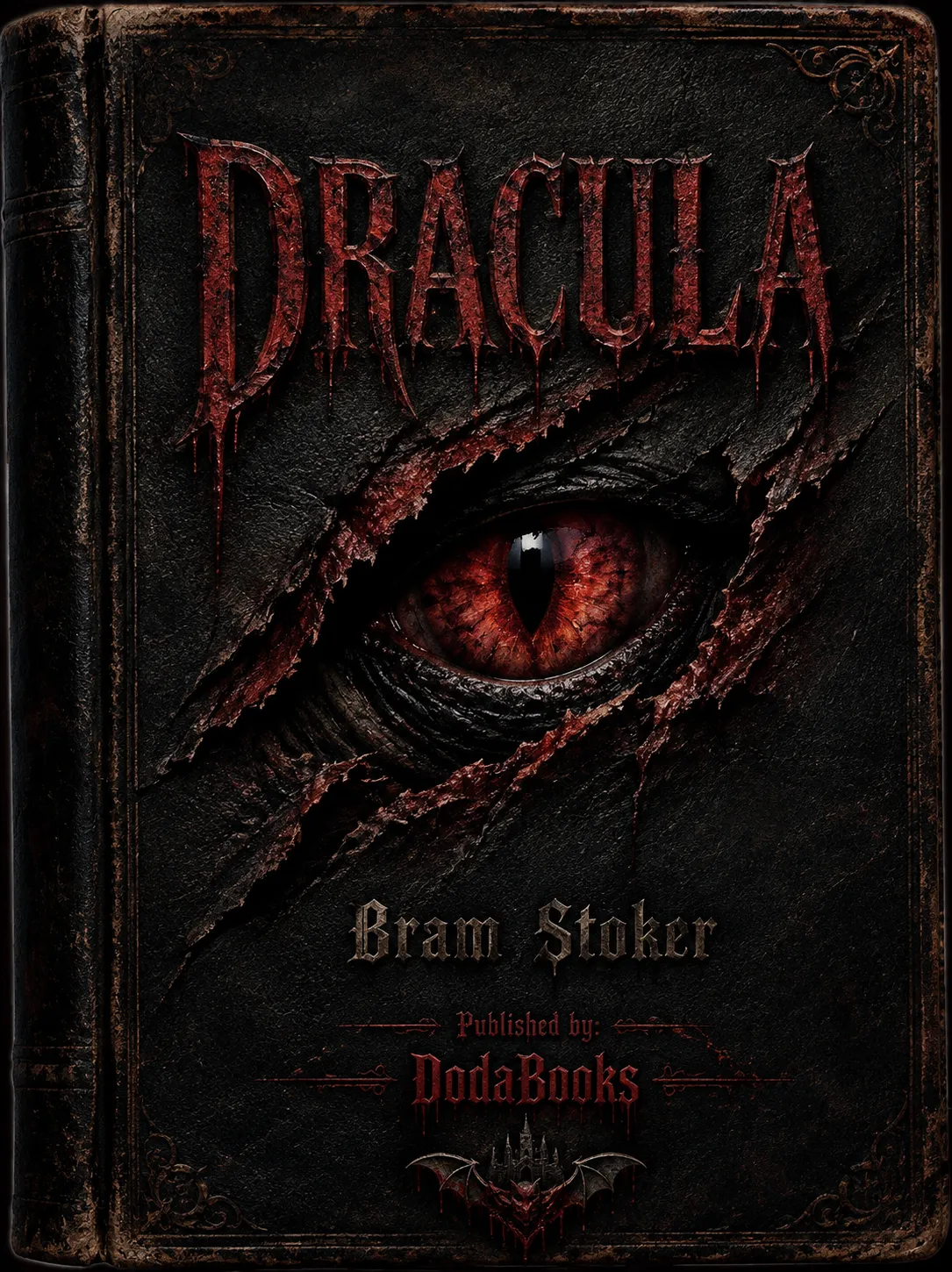
This edition presents the complete 1897 text, carefully formatted for modern e-readers and beautifully finished with a new 3D design cover.
Zero Distractions
No ads, no license pages, no project boilerplate — just the original novel, clean and uninterrupted.
Smart Typography
Curly quotes, em-dashes, proper ellipsis — typeset with care for a premium reading experience.
Chapter Navigation
Full table of contents with back-to-chapter links in every section — jump between all 27 chapters effortlessly.
Cleaned & Polished
All Gutenberg boilerplate stripped, consistent formatting throughout the text.
3D Design Cover
A beautifully designed cover that makes your digital library stand out.
Free Lifetime Updates
Download future editions of this book at no extra cost — plus instant EPUB delivery.
🏛️ Historical Context: The Real Dracula and Victorian Fears
Stoker drew on both medieval history and contemporary dread. The name Dracula derives from the historical Vlad III Dracula, better known as Vlad the Impaler, whose brutal fifteenth-century rule over Wallachia earned him a blood-soaked reputation that Stoker mined for atmosphere. But Stoker was writing in the late 1890s, and his real subject was the nervousness of his own time.
Victorian readers were anxious about immigration, the collapse of empire, and the changing place of women and science. Dracula’s invasion of England — arriving by ship at Whitby, then taking root in London through purchased property and disguised coffins of earth — reads as a metaphor for every foreign influence that unsettled polite society. Understanding this anxiety is part of what makes the book so rich. For more on the Gothic tradition Stoker worked in, see our guide to Frankenstein, which defined the monster that haunted the Victorians before Dracula did.
🔮 Themes: Modernity vs. Ancient Evil
The central tension of the novel is the clash between rational modernity and ancient, irrational evil. Van Helsing is the key figure here — a man of science who nonetheless understands that the threat Dracula poses cannot be met with scalpel or microscope alone. He must combine modern medicine with folk wisdom, faith, and superstition.
This theme plays out in the novel’s technology as well. Typewriters, phonographs, blood transfusions, and even psychiatric observation are all present, and the heroes use every modern tool at their disposal. Yet the vampire, as ancient as legend, slips through the gaps in their rational worldview. Stoker’s message is that reason alone is not enough to confront the darkness. This pairing of science with the supernatural also drives Stevenson’s The Strange Case of Dr Jekyll and Mr Hyde, another London horror that questions Victorian faith in progress.
✍️ Reading Tips for a Faster, Deeper Read
Dracula is built for momentum, but its cumulative horror rewards attention. On a first read, let the epistolary format carry you — trust the fragments and let the mystery build. Resist skipping the newspaper clippings and ship logs; they are not filler but essential evidence. On a second read, pay close attention to Mina’s role: she is the group’s true strategist. If you are new to the genre, reading other Victorian horror helps you spot the patterns Stoker helped establish.
❓ Frequently Asked Questions
Is Count Dracula sympathetic in the original novel?
Less so than in most adaptations. Stoker’s Dracula is more monster than tragic figure — ancient, predatory, and view ing humans as cattle. While he possesses charisma and intelligence, the novel presents him as genuine evil rather than a misunderstood antihero.
How does the epistolary format work?
The novel is composed entirely of documents — journals, letters, newspaper clippings, and phonograph recordings. Each character contributes their perspective, and the reader assembles the full story from these fragments. This creates powerful suspense and a sense of documentary realism.
How long does it take to read?
At roughly 400 pages across 27 chapters, most readers finish in 8–12 hours over several days. The short chapters and constant shifts between narrators keep the pace lively.
Is this the same story as the movies?
Stoker’s novel differs significantly from most film adaptations. The plot is more complex, several characters play larger roles, and the ending is different from what you may expect. Reading the original reveals a richer, stranger story than any single adaptation captures.
Why was Dracula so influential?
Stoker synthesized centuries of vampire folklore into a single, compelling figure. His Count established the rules and imagery that define vampires in popular culture — the castle, the coffin, the blood-drinking, the vulnerability to sunlight. Every vampire since owes a debt to Dracula.
Who is Van Helsing and why is he important?
Abraham Van Helsing is a Dutch physician and scholar summoned when Lucy’s mysterious illness defeats modern medicine. He recognizes the signs of vampirism and leads the small band of hunters, combining science, faith, and folk knowledge. He is the only character who truly understands what they face.
Is Dracula based on a real person?
Stoker took the name and some atmosphere from Vlad III Dracula, a fifteenth-century Wallachian ruler known as Vlad the Impaler. However, the Count’s powers, personality, and story are almost entirely fictional. The historical Vlad is a distant echo, not the blueprint for the character.
📚 Related Articles
📖 Read the Original Classic
Dracula is one of the most important horror novels ever written. The DodaBooks edition preserves the complete original text in a clean, distraction-free format with a beautiful 3D design cover:
- ✅ Complete 27-chapter novel — every word of the 1897 edition
- ✒️ Smart typography — curly quotes, em-dashes, proper ellipsis
- 📜 Full table of contents with chapter navigation
- 📚 3D design cover — a cover that makes your library stand out
- 🔄 Free lifetime updates — future editions at no extra cost
- 📥 Instant download — EPUB format included