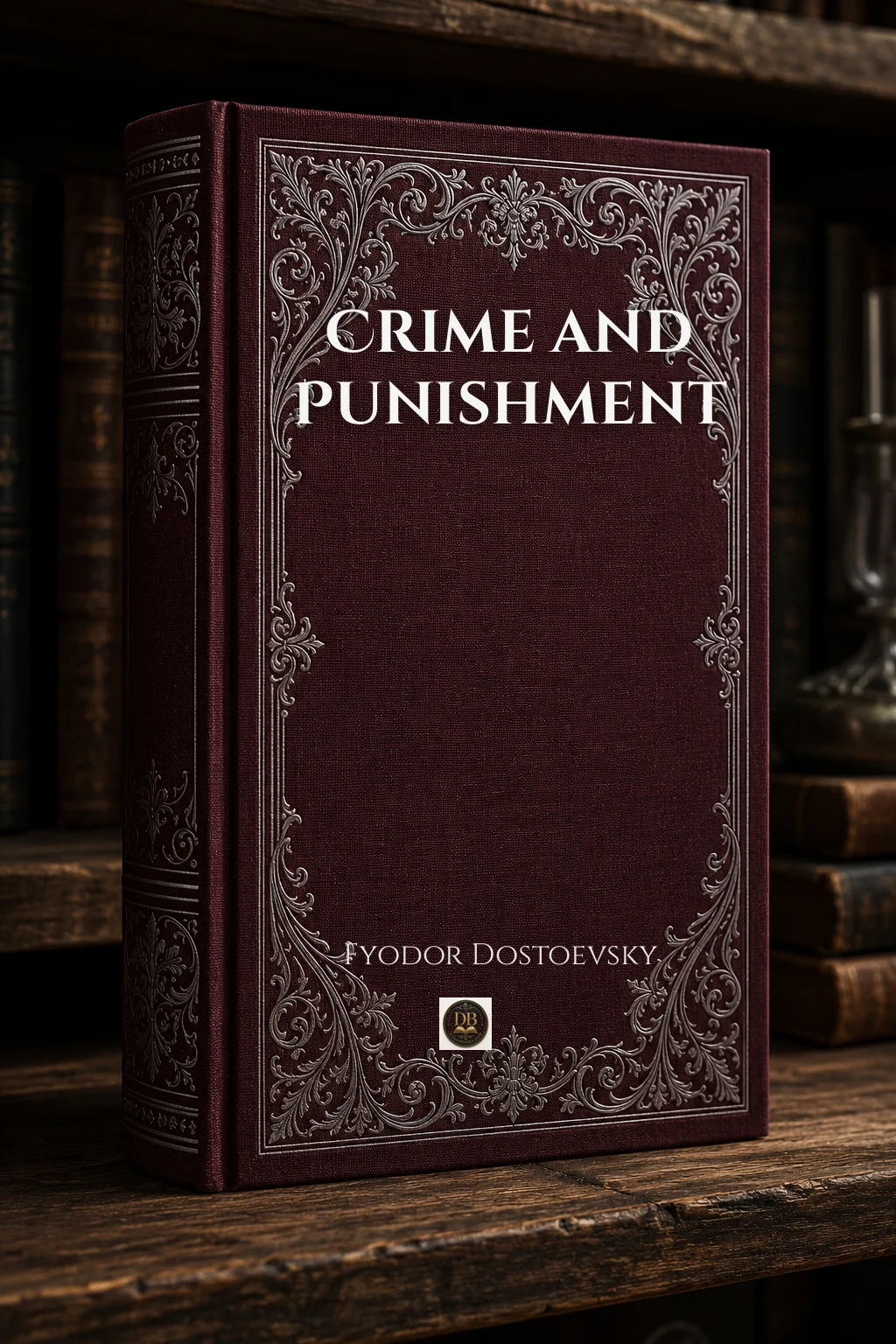
Fyodor Dostoevsky’s Crime and Punishment follows Rodion Raskolnikov, a destitute former student who murders an elderly pawnbroker and must grapple with the psychological torment of his crime. Published in 1866, it is one of the greatest novels ever written — a profound exploration of morality, guilt, and redemption.
🪓
Crime and Punishment
A destitute student commits murder, then battles the psychological torment of his crime — Dostoevsky's profound 1866 exploration of guilt and redemption.
| Author | Fyodor Dostoevsky |
| Published | 1866 |
| Genre | Psychological fiction, philosophical novel, crime fiction |
| Chapters | 41 (6 parts + epilogue) |
| Setting | 1860s St. Petersburg, Russia — cramped apartments, taverns, police stations, and the city’s squalid streets |
| Legacy | One of the greatest novels ever written; a profound exploration of morality, guilt, and redemption |
🪓 The Story
Rodion Raskolnikov, a brilliant but impoverished former law student, conceives a theory that certain extraordinary individuals are above moral law. To test whether he is one of them — and to relieve his desperate poverty — he murders Alyona Ivanovna, an elderly pawnbroker, with an axe. The crime does not go as planned, and he is forced to kill her innocent sister Lizaveta as well.
The murder does not free Raskolnikov as he expected. Instead, it plunges him into a spiral of paranoia, fever, and psychological torment. The brilliant detective Porfiry Petrovich begins closing in, not with evidence but with psychological pressure, engaging Raskolnikov in cat-and-mouse conversations that slowly expose his guilt.
The novel’s true drama unfolds in Raskolnikov’s relationships — with the devout Sonya Marmeladova, who urges him to confess; with his devoted sister Dunya, whose own sacrifices mirror his; and with the dissolute Svidrigailov, a man who has crossed every moral boundary and found only emptiness on the other side.
🎭 Key Characters
Rodion Raskolnikov
Raskolnikov is the novel’s tortured center — a man of extraordinary intelligence and equally extraordinary pride. His theory that great individuals are permitted to transgress moral law is intellectually seductive but morally catastrophic. The novel traces his journey from intellectual arrogance through psychological collapse to the possibility of redemption.
Sonya Marmeladova
A young woman forced into prostitution to support her family, Sonya is the novel’s moral compass. Her faith is unshakeable, her compassion unlimited, and her reading of the story of Lazarus to Raskolnikov is one of literature’s most powerful scenes. She represents the possibility of grace even in the darkest circumstances.
Porfiry Petrovich
The investigating magistrate, Porfiry is one of fiction’s great detectives. He has no physical evidence against Raskolnikov, but he understands human psychology with devastating precision. His conversations with Raskolnikov are psychological chess games of extraordinary tension.
Svidrigailov
Dunya’s former employer and pursuer, Svidrigailov is Raskolnikov’s dark mirror. Where Raskolnikov still has the capacity for guilt and redemption, Svidrigailov has crossed every boundary and found only boredom and despair. His fate serves as a warning of what Raskolnikov could become.
📖 Literary Significance
Crime and Punishment is widely considered one of the greatest novels ever written. Dostoevsky’s achievement is to combine a gripping crime story with profound philosophical inquiry. The novel asks whether there are circumstances that justify murder — and answers with a devastating portrait of what such justification costs the human soul.
The novel’s psychological depth was revolutionary. Dostoevsky anticipated Freudian psychoanalysis by decades, exploring the unconscious motivations, self-deception, and rationalizations that drive human behavior. Raskolnikov’s internal monologue — shifting between justification, guilt, and denial — is rendered with unprecedented precision.
St. Petersburg itself functions as a character in the novel. The squalid streets, cramped apartments, and oppressive heat mirror Raskolnikov’s psychological state. Dostoevsky uses the physical environment to externalize internal torment, creating one of the most vivid cityscapes in literature.
✨ What Makes the DodaBooks Edition Special
This is the original 1866 text, carefully prepared for modern readers without distractions or clutter.
Zero Distractions
No ads, no license pages, no project boilerplate — just the original novel, clean and uninterrupted.
Smart Typography
Curly quotes, em-dashes, proper ellipsis — typeset with care for a premium reading experience.
Chapter Navigation
Full table of contents with back-to-chapter links in every section — jump between all 41 chapters effortlessly.
Cleaned & Polished
All Gutenberg boilerplate stripped, consistent formatting throughout the text.
No DRM
You own your copy — read on any device, anytime, forever.
Instant Download
EPUB + PDF + AZW3 formats included, delivered instantly after purchase.
🏛️ Historical Context: St. Petersburg in the 1860s
Crime and Punishment cannot be understood apart from the Russia of the 1860s. Published in 1866, it emerged from a moment of intense social upheaval — serfdom had only been abolished in 1861, and the country was wrestling with new ideas about progress and the individual’s place in society. The slums, taverns, and rented rooms of St. Petersburg were real places, and his portrait of a young, educated man pushed to the edge of starvation captures genuine anxieties of the era.
Dostoevsky wrote the novel during one of the most turbulent periods of his own life, publishing it serially while still paying off debts and trying to save his brother’s widow. He knew poverty intimately, having been imprisoned and exiled to Siberia in his twenties, and that lived experience gives the novel its authenticity. Raskolnikov is not a cartoon villain but a believable product of a specific time and place.
🔮 The Big Ideas: Guilt, Suffering, and Redemption
The engine of the novel is Raskolnikov’s theory — that a “genius” may be permitted to step beyond ordinary morality if his crime serves a higher purpose. Dostoevsky sets this dangerous idea against Sonya’s unwavering faith, and the novel argues, in the end, against it. Where Raskolnikov isolates himself, believing he is above and apart from other people, Sonya connects herself to others through suffering and compassion. Redemption comes from humbling oneself and re-entering the human community.
Dostoevsky also anticipates modern psychology with astonishing clarity. Raskolnikov’s feverish self-justification, his alternating boasting and terror, and his compulsion to revisit the scene of the crime are rendered with a power that still unsettles readers. If you are drawn to this territory, The Brothers Karamazov, Dostoevsky’s final novel, deepens the same obsessions with faith, doubt, and moral responsibility.
🧭 How to Read This Novel
The novel’s length and the Russian naming conventions intimidate many readers, but a few simple tactics make it far more approachable. Expect to encounter each character under several names — Raskolnikov may appear as “Rodion,” “Rodya,” or “Raskolnikov” in the same chapter. Track the handful of names that matter most and let the rest fill in through context. Reading in stretches of two or three chapters works well, since the psychological tension builds in waves.
It also helps to decide early what you are reading for. On one level this is a macabre crime story, gripping and full of suspense; on another it is a philosophical dialogue about the limits of reason. Once you begin the unforgettable final section, the pace picks up.
📖 Themes That Resonate Today
What gives Crime and Punishment its modern power is how recognisable its dilemmas remain. Raskolnikov’s conviction that he is justified — that ordinary rules do not apply to him — echoes in every era of ambitious young men. Dostoevsky’s warning is that the cost of convincing yourself you are above morality is the destruction of your own humanity.
The novel is also a deeply compassionate study of poverty and its humiliations. The Marmeladov family’s grinding deprivation is drawn with painful sympathy, and Dostoevsky makes us feel the social forces that drive Sonya into the streets. For a very different portrait of a mind under strain, our guide to Frankenstein explores another classic meditation on ambition and its monstrous consequences.
❓ Frequently Asked Questions
Is Crime and Punishment based on a true story?
While the novel is not a direct adaptation of real events, Dostoevsky was influenced by several actual murder cases and by the philosophical debates of his time. The character of Raskolnikov reflects real currents in Russian radical thought, particularly the idea that extraordinary individuals are above conventional morality.
How long does it take to read at 746 pages?
Most readers take 15-20 hours to finish the DodaBooks edition. The novel is divided into six parts and an epilogue, making it easy to read in manageable sessions. Dostoevsky’s prose is dense but gripping, and many readers find the pages fly by despite the length.
Is it hard to read?
The novel is challenging but rewarding. The biggest difficulty for many readers is keeping track of the large cast of characters and the complex Russian naming conventions. However, the psychological drama is gripping, and the DodaBooks edition’s clean formatting and chapter navigation make it easier to follow.
What is Raskolnikov's theory?
Raskolnikov argues that humanity divides into two categories: ordinary people who must follow moral law, and extraordinary individuals (like Napoleon) who have the right to transgress it for a higher purpose. He murders the pawnbroker to test whether he belongs to the second category. The novel demonstrates that such theories collapse when confronted with the reality of taking a human life.
Should I read the Garnett or a newer translation?
The DodaBooks edition uses a carefully prepared text that balances readability with faithfulness to Dostoevsky’s original. The Garnett translation (1914) is the classic English version, while newer translations by Pevear and Volokhonsky (1990) and others offer different strengths. Any translation will convey the novel’s power.
What is the meaning of the novel's title?
The title names the novel’s central movement: the crime is Raskolnikov’s murder of the pawnbroker, and the punishment is not the legal sentence he eventually receives but the psychological torment he endures long before he is caught. Dostoevsky suggests that the real punishment for wrongdoing is the destruction of the self — guilt, paranoia, and spiritual isolation that no theory can justify away.
Does Raskolnikov get away with the murder?
No. Although he evades legal detection through most of the novel, he eventually confesses to Sonya and then to the authorities. He is sentenced to hard labour in Siberia, but the deeper story is that he could never escape his own conscience. The novel is less about whether he is caught than about whether he can be redeemed.
Why is St. Petersburg so important to the story?
Dostoevsky uses the city as a mirror of Raskolnikov’s mind. The cramped rooms, glaring yellow walls, oppressive heat, and crowded streets externalise his feverish, hounded mental state. The physical environment is not just a setting but an active force in the novel, pressuring and enclosing the characters.
📚 Related Articles
To examine the philosophical dismantle of moral absolutes and the will to power, read our study of Nietzsche’s Beyond Good and Evil Guide.
🪓 Read the Original Masterpiece
Crime and Punishment is one of the greatest novels ever written. The DodaBooks edition preserves the complete original text in a clean, distraction-free format:
- ✅ Complete 41-chapter novel — every word of the 1866 edition
- ✒️ Smart typography — curly quotes, em-dashes, proper ellipsis
- 📜 Full table of contents with chapter navigation
- 🔒 DRM-free — read on any device, anytime
- 📥 Instant download — EPUB + PDF + AZW3 formats
For an unforgettable, firsthand insider diagnosis of the fall of the Tsardom and the Romanov dynasty, read Dr. E.J. Dillon’s The Eclipse of Russia Guide.