Why is “Call me Ishmael” the most famous opening line in novel history? Herman Melville opens Moby-Dick (1851) with three unassuming words that immediately establish an enigmatic narrator, a biblical outcast identity, and one of literature’s greatest psychological journeys.
🐋
Call Me Ishmael: The Most Famous Opening Line in Literature Explained
Why is 'Call me Ishmael' the most famous opening line in American literature? Discover the meaning and genius of Moby-Di...
Three Words That Changed Literature
“Call me Ishmael.” Three words. Nine letters. The opening of Moby-Dick is deceptively simple. But beneath the surface, it contains the entire novel in miniature.
When Herman Melville published Moby-Dick in 1851, he could not have known that his opening line would become the most analyzed sentence in American literature. Yet here we are, more than 170 years later, still unpacking what those three words mean — and why they feel so different from every other opening line ever written.
The genius of “Call me Ishmael” is that it performs what it describes. It does not tell us who the narrator is. It tells us what to call him. There is a crucial difference, and Melville knew it. A name is an identity. A name spoken aloud is a social contract. By asking us to call him Ishmael, the narrator is not introducing himself — he is inviting us into a relationship.
Consider what other famous opening lines accomplish. “It was the best of times, it was the worst of times” establishes an era. “It is a truth universally acknowledged” establishes a social norm. “Call me Ishmael” establishes a person — or rather, it establishes the idea of a person, which is something far more interesting.
What the Line Achieves
📖 Want the complete annotated experience?
👉 Get the Annotated EditionThe opening line of Moby-Dick accomplishes four remarkable things in a single sentence. Each layer reveals something essential about the novel to come:
It establishes voice. The narrator is informal, direct, and personal. He speaks to us as a friend, not as a lecturer. The tone is conversational, almost casual — yet something about the phrasing suggests depths beneath the surface. This is the voice of a man who has been through something extraordinary and is choosing, carefully, how to tell us about it.
It creates mystery. He does not tell us his real name. Why does he hide it? The act of renaming oneself is loaded with meaning. In the Bible, characters receive new names when their destinies change — Abram becomes Abraham, Jacob becomes Israel. By choosing a name rather than being given one, Ishmael signals that he is the author of his own transformation. He is not what he was. He is what he has become.
It alludes to the Bible. Ishmael is the outcast son of Abraham — a wanderer and survivor. In Genesis, Ishmael is cast out into the wilderness with his mother Hagar, where he nearly dies before God promises that he will become the father of a great nation. The biblical Ishmael is both cursed and blessed, abandoned and chosen. Melville’s narrator mirrors this duality: he is a survivor, the only one who lives to tell the tale, yet he is also rootless, drifting through the world without anchor or home.
It invites complicity. “Call me” — we are participants in the naming. The imperative mood places us in the scene, standing before this man, agreeing to his terms. We are not passive readers. We are active collaborators in the act of storytelling. From the very first sentence, Melville has made us responsible for what comes next.
There is a fifth achievement that critics often overlook: it establishes unreliability. The narrator asks us to call him something. He does not say “my name is Ishmael.” He says “Call me Ishmael.” The distinction is everything. A name is a fact. A name requested is a performance. From the first word, we sense that this narrator may not be entirely trustworthy — that the story he is about to tell us may be shaped, colored, even invented.
The Grammar
The sentence has no subject. “Call me Ishmael” is an imperative — a gentle command. Compare alternatives: “My name is Ishmael” would be flat, a simple statement of fact. “I am called Ishmael” would be passive, suggesting that others have assigned him this name. “Call me Ishmael” is active, intimate, and mysterious. It places the reader in the role of someone being addressed directly, creating an immediate bond.
The imperative mood is unusual for a novel’s opening. Most first-person narrators begin by stating something — their name, their circumstances, their intentions. Ishmael begins by asking us to do something. This is not a man who introduces himself. This is a man who introduces a relationship. The difference is subtle but profound, and it sets the tone for the entire novel.
Melville also understood something about the rhythm of English prose. “Call me Ishmael” follows a iambic pattern — da-DUM da-DUM da-DUM — that gives it the cadence of poetry. It is a line that invites repetition, that lodges in the memory, that becomes a kind of incantation. This is not accidental. Melville was a deeply musical writer, and the opening line functions almost as the novel’s first note, setting the key for everything that follows.
What Follows
Ishmael explains why he goes to sea: “Whenever I find myself growing grim about the mouth; whenever it is a damp, drizzly November in my soul; whenever I find myself involuntarily pausing before coffin warehouses, and bringing up the rear of every funeral I meet; and especially whenever my hypos get such an upper hand of me, that it requires a strong moral principle to prevent me from deliberately stepping into the street, and methodically knocking people’s hats off — then, I account it high time to get to sea as soon as I can.”
The first paragraph paints a complete psychological portrait: a man on the edge, drawn to the ocean as medicine for a mind that is turning dark. The passage moves from physical description (the grim mouth, the drizzly soul) to increasingly desperate behavior (pausing before coffin warehouses, following funerals) to barely contained violence (knocking people’s hats off) to the final resolution: the sea.
Notice how the passage builds. Each clause escalates the narrator’s distress. The metaphors become more concrete, more physical, more alarming. By the time Ishmael reaches the ocean, we understand that this is not a vacation — it is a flight. He is escaping something, even if he cannot name what it is. The sea is not a destination. It is a remedy.
This paragraph also establishes one of the novel’s central themes: the relationship between the interior self and the exterior world. Ishmael’s “damp, drizzly November” is not the weather. It is his mind. The coffin warehouses he pauses before are not curiosities — they are projections of his inner state. When he says he is going to sea, he means he is going to confront something vast and uncontrollable, something that might save him or destroy him.
The Legacy
“Call me Ishmael” is referenced and parodied everywhere from The Simpsons to academic conferences. It has been translated into dozens of languages, adapted into films, quoted in political speeches, and studied in literature courses around the world. The line endures because it is perfect: three words that contain a world.
The parodies tell us something important about the line’s power. When writers want to evoke the feeling of a classic novel — the weight of literary history, the gravity of a narrator about to tell a great story — they echo “Call me Ishmael.” The line has become a shorthand for literary ambition itself. To parody it is to acknowledge its authority.
But the line’s true legacy is not cultural. It is structural. Before Melville, novel openings tended to be formal, declarative, distanced. “Call me Ishmael” broke that pattern. It said: a novel can begin the way a conversation begins. It can be intimate, informal, personal. It can address the reader directly. The opening line of Moby-Dick helped create the modern American novel — a form that values voice, personality, and the singular perspective of a single human consciousness.
The line also endures because it remains unresolved. We never learn Ishmael’s real name. We never learn why he chose this particular name. The mystery deepens with every reading, every generation, every new reader who picks up the book and encounters those three words for the first time. “Call me Ishmael” is not an opening. It is an invitation — and the voyage it initiates has no end.
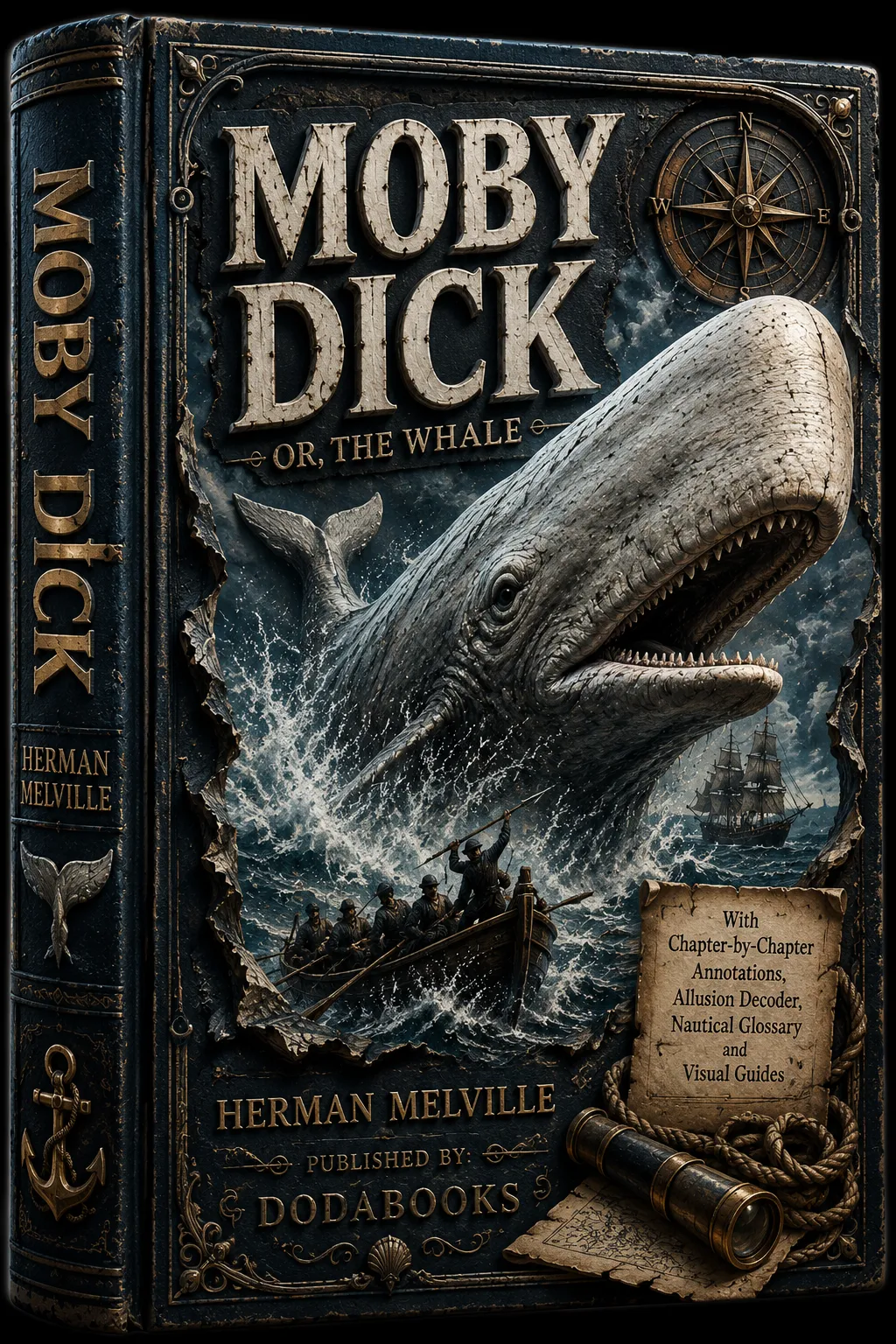
Discover the depth of Melville’s masterpiece with our annotated edition of Moby-Dick. Complete text with explanatory notes, historical context, and literary analysis.
📚 Related Articles
Frequently Asked Questions
What is the significance of 'Call me Ishmael'?
The line introduces an ambiguous narrator with biblical resonance; in Genesis, Ishmael is an exile and wanderer, foreshadowing the narrator's outsider perspective.
Is Ishmael the narrator's real name?
Melville deliberately leaves this ambiguous; 'Call me Ishmael' suggests an adopted persona or symbolic identity rather than a verified legal name.
Why is this opening sentence considered one of the greatest in literature?
It immediately establishes tone, mystery, and intimate narrative address in just three words, commanding the reader's attention.
How does the opening sentence connect to the rest of the novel?
It establishes Ishmael's melancholy and spiritual restlessness, explaining why he turns to the ocean whenever a 'damp, drizzly November' settles in his soul.
Where can I explore full chapter-by-chapter breakdowns of Melville's prose?
The DodaBooks annotated edition provides rich line-by-line commentary, historical footnotes, and thematic analysis for every chapter of Moby-Dick.
Beyond its opening sentence, explore our definitive analysis of the Best Moby-Dick Quotes Analyzed across Melville’s maritime epic.
🎯 Stop Struggling. Start Understanding.
The annotated edition of Moby-Dick gives you everything you need to finally get Melville’s masterpiece:
- ✅ Complete, unabridged text — every word of the original 1851 edition
- ✅ Hundreds of explanatory footnotes — no more Googling every other page
- ✅ Historical context — the Essex disaster, Nantucket whaling, Melville’s life
- ✅ Literary analysis — chapter-by-chapter commentary on themes and symbols
- ✅ Victorian vocabulary — obsolete words and nautical terms defined inline
- ✅ Biblical & literary references — every allusion traced to its source