Finished Moby-Dick? Here are 10 similar books — sea adventures, philosophical novels, and epic quests for fans of Melville.
🐋
Books Like Moby-Dick: What to Read Next
Finished Moby-Dick? Here are 10 similar books — sea adventures, philosophical novels, and epic quests for fans of Melvil...
More Sea Adventures
If it’s the ocean that drew you to Moby-Dick — the terror and beauty of deep water, the isolation of life at sea, the physical reality of sailing a wooden ship across the Pacific — these books deliver that experience with their own distinct voices.
The Old Man and the Sea by Hemingway — This Pulitzer Prize-winning novella strips the sea story to its barest elements: an old Cuban fisherman, a giant marlin, and the struggle between human endurance and nature. At just over 100 pages, it’s the opposite of Moby-Dick’s encyclopedic ambition, yet it shares the same fundamental question: what happens when a man stakes everything on a single encounter with a creature that may be stronger than he is? Hemingway’s spare prose is the perfect palate cleanser after Melville’s verbal extravagance.
Two Years Before the Mast by Dana — Published in 1840, just eleven years before Moby-Dick, this true account of life on a 19th-century sailing ship provides the real-world backdrop against which Melville’s fiction plays out. Dana shipped as a common sailor on a merchant vessel around Cape Horn, and his descriptions of the physical labor, the danger, and the camaraderie of shipboard life will deepen your appreciation for the world Melville recreates.
The Riddle of the Sands by Childers — A pioneering spy thriller set on a small sailboat in the Frisian Islands. The sailing is meticulously described, and the tension between the two main characters mirrors the dynamics of shipboard life in Moby-Dick — two men dependent on each other, reading each other’s moods, navigating both the sea and their own relationship. Published in 1903, the novel is often credited with alerting Britain to the military threat from Germany before World War I, and it remains one of the finest sea novels in the English language.
The Sea-Wolf by Jack London — London’s 1904 novel features another tyrannical captain, Wolf Larsen, whose intellectual brilliance and physical courage make him both admirable and terrifying. Like Ahab, Larsen is a force of nature who dominates everyone around him — but where Ahab is driven by obsession, Larsen is driven by nihilism, believing that life has no meaning and that only strength matters. The contrast between the two captains illuminates what makes Ahab unique: his madness is purposeful, while Larsen’s is philosophical. London’s novel is shorter and more straightforward than Moby-Dick, making it an accessible next step for readers who want more of the captain-and-crew dynamic without the encyclopedic digressions.
Epic Quests
📖 Want the complete annotated experience?
👉 Get the Annotated EditionIf it’s the quest narrative that captivated you — the sense of a journey with stakes that feel cosmically important — these books share that epic quality.
The Odyssey by Homer — The original epic journey. Odysseus’s ten-year struggle to return home after the Trojan War established the template that Melville draws on: a hero defined by his quest, aided and obstructed by forces beyond his control, struggling against a universe that seems designed to thwart his return. Melville knew Homer well, and Moby-Dick’s structure — the wandering, the encounters with exotic peoples, the desperate homecoming — echoes the Odyssey in ways that reward comparison. The key difference is tonal: Homer’s hero wants to go home; Ahab wants to destroy the thing that hurt him. The Odyssey is about return; Moby-Dick is about revenge. Both are about the cost of the journey, and both suggest that the traveler is transformed by what he encounters along the way.
Heart of Darkness by Conrad — A shorter, darker obsession story set in the Congo. Marlow’s journey upriver to find the enigmatic Kurtz mirrors Ahab’s pursuit of the whale: both men are drawn deeper into a darkness that promises revelation and delivers destruction. Conrad’s compressed, atmospheric prose offers a different model for how to write about obsession than Melville’s expansive one.
The Grapes of Wrath by Steinbeck — An American journey and struggle, told with Steinbeck’s characteristic blend of social consciousness and lyrical description. The Joad family’s migration west shares the Pequod’s sense of a community bound together by circumstance, moving toward a destination that may not offer the salvation they seek. Steinbeck’s novel, like Moby-Dick, is ultimately about the tension between individual will and collective fate — and about the systems that crush those who cannot escape them.
Philosophical Novels
If it’s the intellectual ambition of Moby-Dick — the cetology chapters, the philosophical digressions, the sense that the novel is trying to contain all of human knowledge — these books match that ambition.
Infinite Jest by David Foster Wallace — Massive, digressive, encyclopedic, and darkly funny. Wallace’s 1996 novel shares Moby-Dick’s structural daring — it footnotes its footnotes, shifts between narratives that don’t seem connected until they are, and refuses to let the reader settle into a comfortable reading mode. Like Moby-Dick, it rewards patience and rereading, and like Melville, Wallace was interested in the gap between what people say and what they actually mean. The novel’s 1,079 pages may seem daunting, but readers who loved Moby-Dick’s cetology chapters will find a kindred spirit in Wallace’s exhaustive explorations of tennis, addiction, and the entertainment industry.
Gravity’s Rainbow by Pynchon — A maximalist novel that mixes high and low culture, science and paranoia, comedy and tragedy, in a way that Melville would have recognized and admired. Pynchon’s World War II epic is as digressive as Moby-Dick, as obsessed with systems of knowledge, and as resistant to easy summary. The novel follows a search for a mysterious rocket across wartime Europe, but the rocket is only the surface of a narrative that encompasses everything from colonial history to Pavlovian conditioning to the nature of consciousness itself. Like Moby-Dick, Gravity’s Rainbow rewards readers who surrender to its digressions rather than fighting them — the tangents are where the meaning lives.
Whaling History
If the historical world of whaling fascinated you — the industry, the ships, the real encounters with whales that inspired Melville’s fiction — these books provide the nonfiction foundation. Understanding what whaling actually involved — the danger, the labor, the economics — deepens your appreciation for everything Melville describes in Moby-Dick. The cetology chapters stop feeling like digressions and start feeling like necessary context for a story rooted in a real and brutal industry.
In the Heart of the Sea by Philbrick — The true story of the Essex, the whaling ship that was sunk by a sperm whale in 1820. This is the real event that Melville based Moby-Dick on, and Philbrick’s account brings the disaster to vivid life. Reading it alongside Moby-Dick reveals how Melville transformed historical fact into myth — and how the reality of the Essex disaster, including the crew’s resort to cannibalism, is even more harrowing than fiction.
Leviathan by Philip Hoare — A sweeping exploration of whales, whaling, and Melville that moves between natural history, personal memoir, and literary criticism. Hoare visits the places Melville wrote about, tracks the whales Melville described, and meditates on what the whale means in our own time. It’s part biography of the whale, part biography of Melville, and part autobiography of a writer obsessed with both. The book is a reminder that the fascination Moby-Dick began has never ended — the whale still swims through our cultural imagination, demanding interpretation and resisting understanding.
The Pattern
Readers of Moby-Dick tend to love books that mix adventure with philosophy, use unusual narrative structures, and reward rereading. The list above covers all of these qualities. What connects these books is not their subject matter — sea voyages, quests, philosophical speculation — but their ambition. Each one tries to do something that hasn’t been done before, and each one demands something extra from its reader: patience, attention, a willingness to be confused before being illuminated. If Moby-Dick spoke to you, these books will too.
The deeper pattern is this: Moby-Dick readers tend to be people who enjoy being challenged by a book. They don’t want easy answers or simple plots. They want a book that rewards the effort they put into it — that reveals new layers on rereading, that raises questions it doesn’t answer, that stays with them long after the last page. The books on this list all share that quality. They are not passive entertainment; they are invitations to think, to question, and to see the world differently. That’s what makes them worthy companions to Melville’s masterpiece.
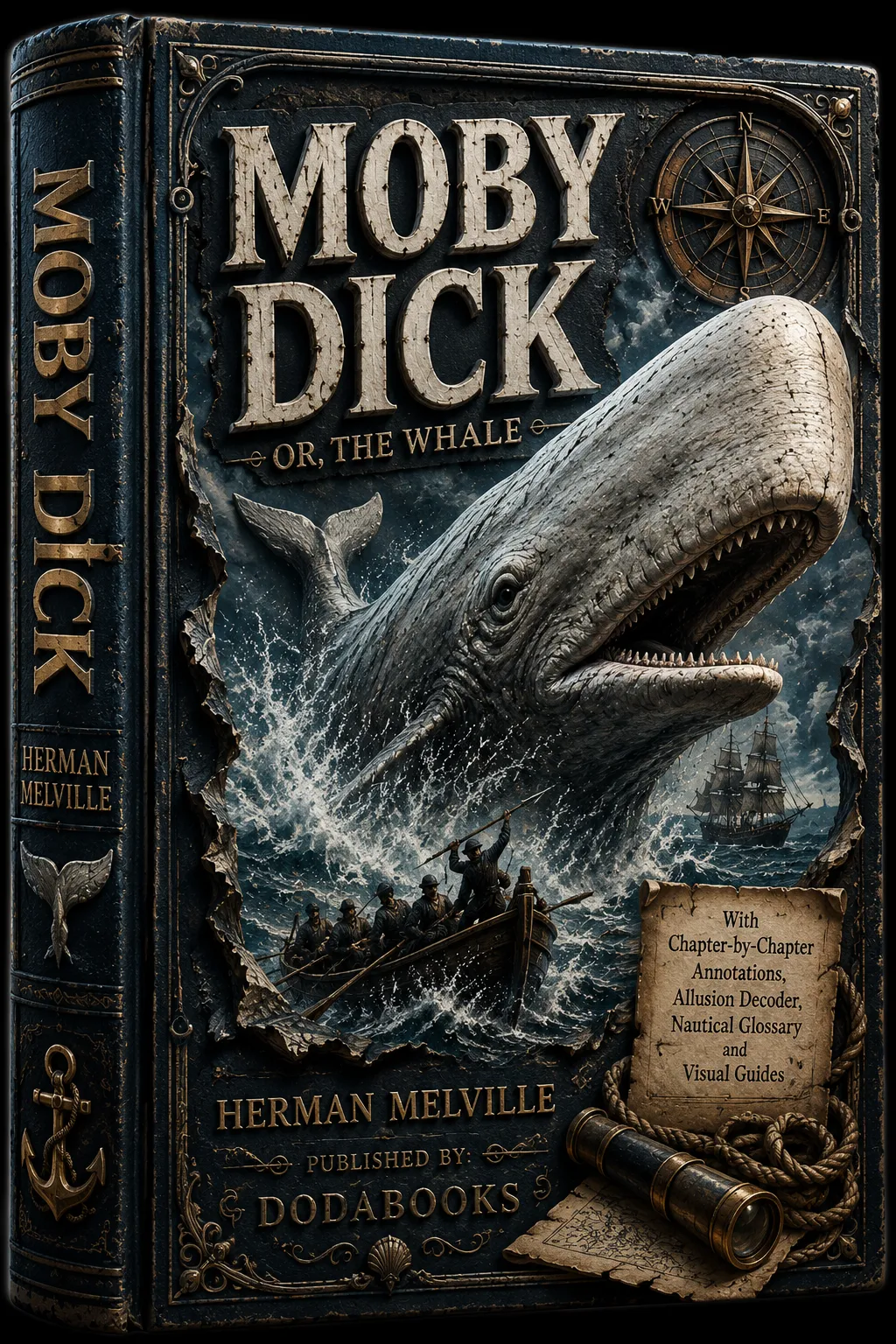
Discover the depth of Melville’s masterpiece with our annotated edition of Moby-Dick. Complete text with explanatory notes, historical context, and literary analysis.
📚 Related Articles
Frequently Asked Questions
What books share Moby-Dick's themes of nautical adventure and obsession?
Joseph Conrad's Heart of Darkness, Samuel Taylor Coleridge's The Rime of the Ancient Mariner, and Ernest Hemingway's The Old Man and the Sea share similar nautical and psychological themes.
What modern novels are comparable to Moby-Dick?
Cormac McCarthy's Blood Meridian and Thomas Pynchon's Gravity's Rainbow capture Melville's epic scope, philosophical depth, and linguistic intensity.
Which other Herman Melville books should I read first?
Billy Budd, Sailor and Benito Cereno are Melville's finest novellas, showcasing his psychological precision and moral ambiguity.
Is Moby-Dick considered an adventure novel or philosophical fiction?
It bridges both genres: on the surface an authentic whaling voyage, and underneath an encyclopedic meditation on fate, knowledge, and existence.
How can I better understand the dense literary allusions in Melville's work?
Reading an annotated edition like the one from DodaBooks provides real-time definitions of maritime jargon, Shakespearean echoes, and biblical motifs directly in line.
🎯 Stop Struggling. Start Understanding.
The annotated edition of Moby-Dick gives you everything you need to finally get Melville’s masterpiece:
- ✅ Complete, unabridged text — every word of the original 1851 edition
- ✅ Hundreds of explanatory footnotes — no more Googling every other page
- ✅ Historical context — the Essex disaster, Nantucket whaling, Melville’s life
- ✅ Literary analysis — chapter-by-chapter commentary on themes and symbols
- ✅ Victorian vocabulary — obsolete words and nautical terms defined inline
- ✅ Biblical & literary references — every allusion traced to its source