The meaning of “A Red, Red Rose” by Robert Burns is both simpler and deeper than most readers expect. On the surface it is a love poem comparing a woman to a rose. Underneath it is a statement about eternal commitment wrapped in deliberate, beautiful exaggeration.
A Red, Red Rose by Robert Burns: Meaning Explained
Every stanza of "A Red, Red Rose" explained in plain English — the rose, the promise, the hyperbole, and why this 18th-century love poem remains one of the most beautiful ever written.
👉 Get the Annotated Edition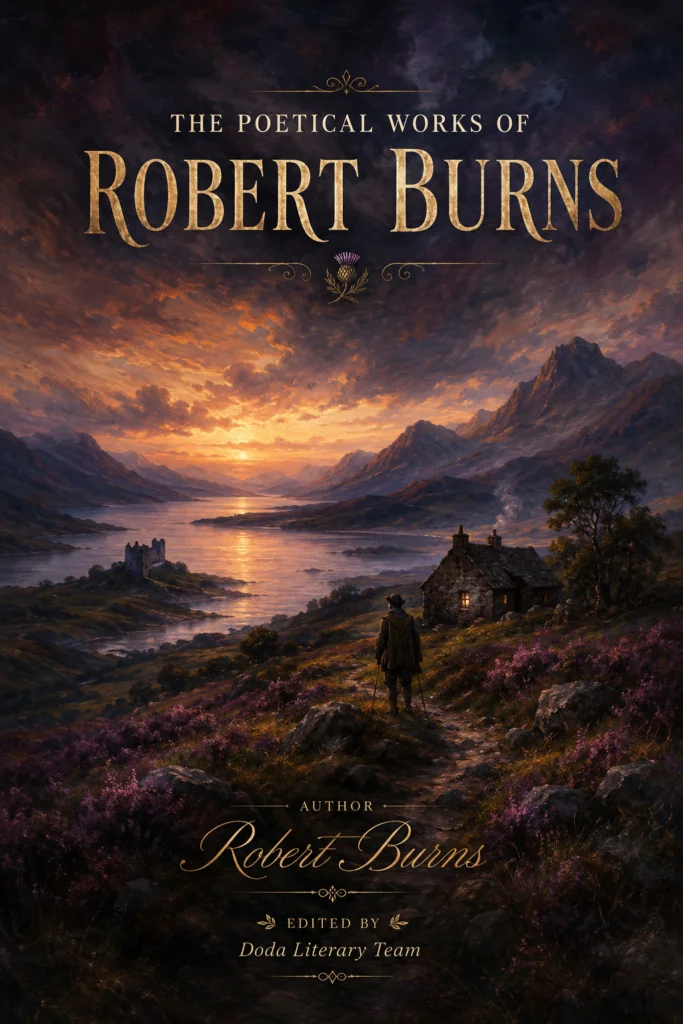
| Poem | “A Red, Red Rose” |
| Written | 1794 |
| Form | Ballad (4 stanzas, 16 lines) |
| Key Theme | Eternal, unconditional love |
| Key Device | Hyperbole (deliberate exaggeration) |
🌹 Stanza 1: The Rose
“O my Luve is like a red, red rose / That’s newly sprung in June”
Burns compares his love to a fresh red rose. The repetition of “red” emphasises intensity. “Newly sprung in June” suggests youth, freshness, and early summer — the peak of life and beauty.
“O my Luve is like the melodie / That’s sweetly play’d in tune”
The second comparison shifts from visual to auditory. His love is also like perfect music — harmonious, pleasing, and emotionally resonant.
🤝 Stanza 2: The Promise
“As fair art thou, my bonnie lass / So deep in luve am I”
Now he addresses the woman directly. Her beauty matches the depth of his feeling.
“And I will luve thee still, my dear / Till a’ the seas gang dry”
Here Burns introduces hyperbole — deliberate exaggeration. He will love her until the seas dry up. This is physically impossible, which is the point. His love is beyond natural limits.
🌍 Stanza 3: The Expansion
“Till a’ the seas gang dry, my dear / And the rocks melt wi’ the sun”
He extends the promise. Not only will the seas dry, but rocks will melt. He is saying his love outlasts geological time.
“And I will luve thee still, my dear / While the sands o’ life shall run”
“Sands of life” means his own lifespan. So his love lasts forever in theory, and at least as long as he lives in practice.
👋 Stanza 4: The Farewell
“Fare thee weel, my only Luve / And fare thee weel awhile”
The final stanza acknowledges a temporary separation. He is leaving but will return.
“And I will come again, my luve / Tho’ it were ten thousand mile”
Even a vast distance will not stop him. The poem ends with loyalty confirmed.
💡 Why This Poem Works
The genius is the escalation. Burns starts with a simple rose, moves to music, then geological time, then personal sacrifice. Each stanza raises the emotional stakes.
📚 Get the full line-by-line analysis of all 539 poems
👉 Get the Annotated Edition🎓 What the Annotated Edition Unlocks
Line-by-Line Explanations
Every line of "A Red, Red Rose" and all 538 other poems is explained in plain English.
Scots Glossary
Look up words like *luve*, *bonnie*, *gang*, and *weel* in the 500+ word glossary.
Literary Device Analysis
Identify and understand the hyperbole, simile, and ballad form that make this poem work.
Historical Context
Learn why Burns wrote this poem, who it was for, and how it fits into his broader body of work.
Teacher's Insights
Ready-made analysis for essays — thematic content, structural choices, and poetic techniques.
Read Anywhere
Works on Kindle, Apple Books, Google Play Books, Kobo, and Foliate.
🏛️ Historical Context: Burns in the 1790s
“A Red, Red Rose” was written in 1794, near the end of Burns’s life and at the height of his fame. He had published the Kilmarnock edition of his poems in 1786 and been feted in Edinburgh, but he had returned to rural Ayrshire to work a farm and, later, to run an excise office — a job collecting taxes on spirits. The poem belongs to his time as one of Scotland’s great song-collectors, when he was reshaping dozens of traditional folk lyrics and tunes for James Johnson’s Scots Musical Museum. This context matters because it changes how we read the poem: Burns was not composing a private love letter but a song meant to be sung, one that deliberately drew on the folk tradition of border ballads and love lyrics.
That folk lineage is why the poem feels at once timeless and utterly of its place. The ballad form — alternating four- and three-beat lines with a simple rhyme — was the natural language of the songs Burns grew up hearing and singing. In the 1790s, the Scottish literary scene was alive with this spirit of collection and revival, and Burns stood at its centre. He took the earthy, repetitive energy of folk song and gave it the polish of a finished poem, which is exactly what makes “A Red, Red Rose” feel so immediately singable even today.
🌹 Reading It as Music
Because Burns wrote for the voice, the best way to appreciate the poem’s craft is to hear its sound. Read the opening three lines aloud and notice the pattern:
“O my Luve is like a red, red rose / That’s newly sprung in June”
The double “red” is partly a metrical device — it fills out the rhythm of the line — but it also does something deeper: it makes the reader pause and dwell on the colour until it becomes almost alive. Burns uses the same instinct in the second stanza, where the repeated “luve” and the rolling “Till a’ the seas gang dry” turn a promise into something you can almost feel building as you read. The poem’s swelling scale is its whole argument, moving your attention outward from a single flower to the entire order of nature.
There is a gentle humility in this that rewards a close second reading. The speaker never claims to be worthy of his love; he only insists on the depth and duration of his own devotion. That is what separates “A Red, Red Rose” from flattery. If you enjoy this poem’s blend of folk music and high feeling, you will almost certainly love Ae Fond Kiss, his other great love lyric, which turns the same intensity toward loss rather than reunion.
💡 Why It Still Works Today
Two hundred years on, “A Red, Red Rose” still shows up at weddings, in film, and in classrooms — and not just out of historical habit. It works because Burns solves a problem that every love poem faces: how to say “I love you forever” without sounding cheap. His solution is hyperbole so grand and so concrete (dried-up seas, melted rocks) that it transcends cliché, and a tune so simple that the emotion stays warm rather than theatrical. It is one of the poems we recommend first to any reader new to Burns, and it sits comfortably beside To a Mouse, which shows a very different side of the same compassionate voice. If you are exploring Burns’s range for the first time, Robert Burns’s nature poetry reveals how the same close attention to the natural world carries over into his animal and landscape poems.
❓ Frequently Asked Questions
What is the main message of "A Red, Red Rose"?
That true love is eternal and transcends time, distance, and even natural limits. Burns uses impossible images (dried-up seas, melted rocks) to emphasise that his love has no boundaries.
Why does Burns repeat the word "red"?
The repetition intensifies the image. A “red rose” is beautiful; a “red, red rose” is passionately, vibrantly beautiful. It emphasises freshness and intensity.
Is this poem about a real person?
The poem was likely written for a general audience as a song, not a specific woman. However, the intense emotion reflects Burns’s own passionate nature.
What poetic devices does Burns use?
Hyperbole (seas drying, rocks melting), simile (like a rose, like a melody), repetition (red, red), and a ballad form with alternating rhyme.
How long does the poem take to read?
About 45 seconds to read aloud. It has 4 stanzas of 4 lines each — 16 lines total.
Why is this poem still popular today?
It captures the feeling of being in love with perfect simplicity and sincerity. The images are universal, and the exaggeration feels romantic rather than ridiculous.
What does "Till a' the seas gang dry" mean?
“A’ the seas gang dry” simply means “all the seas go dry.” The speaker is saying he will love her until the seas dry up — an impossible event — to emphasise that his love has no natural limit or end.
Is "A Red, Red Rose" written in Scots?
Only lightly. Unlike many of Burns’s poems, this one is largely comprehensible to an English reader, with just a few Scots spellings such as luve (love), bonnie (beautiful/pretty), gang (go), and weel (well). That accessibility is one reason it is such a popular introduction to Burns.
What does the "ten thousand mile" line tell us?
The line “Tho’ it were ten thousand mile” reassures the beloved that even a vast distance will not stop the speaker from returning. It is the poem’s final promise — that no geographical separation can undo the loyalty he has declared in every stanza.
📚 Related Articles
Discover every layer of Burns’s greatest love poem
Poems and Songs of Robert Burns — The Annotated Edition
All 539 poems with line-by-line explanations, Scots glossary, and Teacher’s Insights for every line.
👉 Get the Annotated Edition{ .cta-button }