Fascinating facts about Moby-Dick. From the real whale that inspired it to Melville’s rediscovery after death.
🐋
10 Things You Didn't Know About Moby-Dick
Fascinating facts about Moby-Dick. From the real whale that inspired it to Melville's rediscovery after death.
1. The Real Whale Was Mocha Dick
Before Melville ever put pen to paper, a real white whale terrorized the Pacific whaling fleet. Mocha Dick — named after Mocha Island, a small volcanic island off the coast of Chile — was a massive sperm whale known for his extraordinary aggression toward whalers. He was first documented around 1810 and for nearly three decades plagued ships across the South Pacific. According to the New York Knickerbocker Magazine in 1839, Mocha Dick had survived at least thirty encounters with whalers, bearing the scars of harpoons, lances, and line cuts across his enormous white body. He had sunk at least two boats, killed several sailors, and earned a reputation so fearsome that many captains simply refused to hunt in waters where he was known to roam.
What made Mocha Dick remarkable was not just his survival but his deliberate aggression. Unlike most whales, who would flee from approaching boats, Mocha Dick actively attacked. He would charge ships without provocation, smash whaleboats to splinters with his tail, and drag harpooned boats across the ocean for hours before finally escaping. His body was described as predominantly white, though scarred with the dark marks of old wounds — a canvas of violence written in flesh. Whalers who survived encounters with him spoke of his intelligence, his cunning, his almost human determination to destroy the men who hunted him. Melville almost certainly read the 1839 article about Mocha Dick before writing his novel, and the real whale’s characteristics — his whiteness, his aggression, his near-immortality — provided the raw material for the most famous fictional whale in literature. The transformation from Mocha Dick to Moby-Dick involved adding a layer of metaphysical significance to what was already a genuinely terrifying natural phenomenon.
2. Melville Dedicated It to Hawthorne
📖 Want the complete annotated experience?
👉 Get the Annotated EditionThe novel carries one of literature’s most poignant dedications: “In Token of my admiration for his genius, this book is inscribed to Nathaniel Hawthorne.” The friendship between Melville and Hawthorne was brief but extraordinarily intense, lasting roughly from 1850 to 1856, and it fundamentally transformed Melville’s artistic ambitions. Before meeting Hawthorne, Melville was a successful adventure writer — Typee and Omoo had made his name, and he was known as the man who wrote entertaining tales of South Seas voyaging. After meeting Hawthorne, Melville became something altogether more dangerous and more great: a writer obsessed with the deepest questions of human existence.
The two men met in the Berkshire Mountains of Massachusetts in August 1850, at a literary gathering arranged by their publisher. Melville was already deep into writing Moby-Dick, but the encounter with Hawthorne electrified him. In his famous essay “Hawthorne and His Mosses,” written just weeks after their meeting, Melville declared his intention to write something more than mere adventure: “I would write as whim inspired; but as books I would write as Beethoven wrote music.” Hawthorne’s influence can be felt throughout Moby-Dick — in its darkness, its ambiguity, its willingness to confront the possibility that the universe may not be benign. The two men exchanged lengthy letters during the novel’s composition, and Melville clearly craved Hawthorne’s approval, dedicating the book to him as both tribute and offering. The friendship faded after Moby-Dick’s publication, partly because Hawthorne moved away from the Berkshires and partly because Melville’s subsequent work grew increasingly difficult and eccentric. But the brief blaze of their connection produced one of the masterpieces of world literature.
3. The British Title Was “The Whale”
The publication of Moby-Dick was a transatlantic affair that went wrong from the start. The novel first appeared in London in October 1851, published by Richard Bentley under the title The Whale, in a handsome three-volume edition. The American edition followed a month later from Harper & Brothers, this time under Melville’s preferred title. But the British edition contained a critical alteration that would haunt the novel’s reception: the Epilogue was missing.
The Epilogue explains how Ishmael survived the sinking of the Pequod — how he clung to Queequeg’s coffin-buoy and was eventually rescued by the whaling ship Rachel. Without this passage, British readers encountered a story narrated by a man who apparently died along with everyone else on the Pequod. The result was baffling: how could a dead man tell his own story? British reviewers seized on this problem as evidence of Melville’s incompetence. The London Athenaeum declared the novel “an ill-compounded mixture of romance and matter-of-fact,” noting the obvious impossibility of a posthumous narrator. The missing Epilogue was not Melville’s fault — Bentley’s editors made the cut without consulting him — but the damage was done. British reviews, published first, shaped the initial reception and colored American critics’ expectations. The episode illustrates the precariousness of authorial control in the nineteenth-century publishing industry and the extent to which a novel’s fate could be determined by a single editorial decision.
4. It Sold Only 3,000 Copies
The commercial failure of Moby-Dick is one of the great ironies of literary history. During Melville’s entire lifetime, the novel sold approximately 3,000 copies in the United States — a figure that represents a fraction of what Typee had sold a decade earlier. The British edition fared no better. Melville earned roughly $556.37 from the American sales, a sum that would be equivalent to perhaps $18,000 today — hardly enough to sustain a family, let alone justify the years of labor Melville had invested in the book. The first American printing was about 3,000 copies, and it took years to sell through even that modest run. A fire at the Harper & Brothers warehouse in 1853 destroyed the remaining plates, and no new edition was issued during Melville’s lifetime.
The financial failure was devastating, but it was the critical reception that truly broke Melville’s spirit. The reviews were not merely negative — they were bewildered. Critics who had praised Typee and Omoo as charming adventure narratives found Moby-Dick incomprehensible, pretentious, and structurally chaotic. Some suspected that Melville had gone mad. Others suggested he was deliberately trying to alienate his readership. A few perceptive souls — including Melville’s friend Evert Duyckinck — recognized the novel’s extraordinary power, but their voices were overwhelmed by the chorus of confusion and disdain. The failure of Moby-Dick effectively ended Melville’s career as a commercially viable novelist. His next book, Pierre, was even more poorly received, and by the 1860s, Melville had largely abandoned fiction in favor of poetry and a day job as a customs inspector in New York City. The man who had written what would become the Great American Novel spent the last three decades of his life in almost total obscurity.
5. Melville Was a Real Whaleman
Herman Melville’s knowledge of whaling was not academic — it was lived, physical, and dangerous. In December 1840, at the age of twenty-one, Melville shipped aboard the whaler Acushnet out of New Bedford, Massachusetts, bound for the Pacific Ocean. He spent the next eighteen months hunting whales, processing blubber, and enduring the grinding routine and sudden violence of life aboard a working whaling vessel. He witnessed firsthand the brutal efficiency of the whale hunt: the boats lowered into churning water, the harpoon driven into flensing flesh, the long hours of processing the carcass into oil. He saw men maimed and killed. He experienced the hierarchy of a whaling ship — captain, mates, harpooneers, and the largely immigrant crew who did the hardest and most dangerous work.
Melville’s time aboard the Acushnet gave Moby-Dick its extraordinary documentary texture. The cetology chapters — those famously digressive passages about whale anatomy, whale behavior, and the mechanics of whaling — are not merely encyclopedic exercises. They are written from the perspective of a man who had actually stood on the deck of a whaleboat, who had actually seen the spout of a sperm whale rising in the distance, who had actually felt the shuddering impact of a harpoon finding its mark. This firsthand knowledge is what separates Moby-Dick from every other whaling narrative of the nineteenth century. Melville knew the technical vocabulary — the tryworks, the scuttle, the doubloon, the crotch — and he used it with the confidence of a practitioner, not the tentativeness of a researcher. After the Acushnet, Melville deserted the ship in the Marquesas Islands and had further adventures among Pacific Islanders, experiences that provided the material for Typee and Omoo. But it was his whaling experience that gave him the foundation for his masterpiece.
6. The Pequod’s Name Signals Death
The name of Ahab’s ship is not accidental — it is a prophecy. The Pequot were an Algonquian-speaking Native American tribe who inhabited the Connecticut River valley in what is now southeastern Connecticut. In 1637, English colonists and their Mohegan and Narragansett allies fought the Pequot War, a conflict that resulted in the near-total destruction of the Pequot tribe. The war culminated in the Mystic massacre, in which English soldiers and their allies surrounded the main Pequot village and set it ablaze, killing an estimated 400 to 700 men, women, and children. Those who survived were scattered, enslaved, or absorbed into other tribes. The English colonists declared the Pequot name extinguished — they even passed a law forbidding the use of the word “Pequot.”
By naming his ship the Pequod, Melville invokes this history of genocide and destruction. The Pequod is a ship of death from its very christening — named after a people who were annihilated, sailing toward the annihilation of its own crew. The symbolism is characteristic of Melville’s method in Moby-Dick: he takes a historical fact and transforms it into a prophetic symbol, embedding the novel’s tragic结局 within its very language. The ship’s destruction at the end of the novel mirrors the destruction of the Pequot tribe — total, absolute, leaving nothing behind but wreckage and a single survivor. The Pequot name also connects the novel to the broader theme of American expansion and its human costs. The whaling industry that the Pequod represents was itself an engine of exploitation — of whales, of the ocean, of the workers who manned the ships. Melville’s naming of the ship creates a resonance between the historical violence of colonialism and the personal violence of Ahab’s monomania, suggesting that both spring from the same source: the human compulsion to dominate, to destroy, to conquer at any cost.
7. Melville Died Thinking He Had Failed
On the morning of September 28, 1891, Herman Melville died of a heart attack at his home in New York City. He was fifty-eight years old. His death was so unremarkable that the New York Times obituary — published under the headline “Death of Herman Melville” — described him as the author of Typee and Omoo, those early South Seas adventure novels that had made his name three decades earlier. Moby-Dick was not mentioned. Pierre was not mentioned. The obituary noted that Melville had been working as a customs inspector at the New York docks for nearly twenty years, a job he held from 1866 until his retirement in 1885. The picture that emerges is of a man who had been completely forgotten by the literary world — a former adventure writer who had faded into the anonymity of a government clerk’s life.
Melville’s personal life in his final decades was marked by tragedy and isolation. His sons, Malcolm and Stanwix, both predeceased him. His marriage to Elizabeth had become strained and distant. He spent his final years writing poetry that almost no one read — Clarel, a 18,000-line epic poem about faith and doubt set in the Holy Land, was published in 1876 and promptly ignored. When he died, the literary executor of his estate, his friend Evert Duyckinck, donated his manuscripts to the New York Public Library, where they sat largely undisturbed for decades. Melville was buried in the Woodlawn Cemetery in the Bronx, in a plot marked by a simple headstone. The irony is almost unbearable: the man who had created one of the greatest works of American literature died in poverty, obscurity, and the conviction that his life’s work had been wasted.
8. Chapter 32 Is a List
Chapter 32 of Moby-Dick, titled “Cetology,” is one of the most unusual chapters in the novel — and one of the most frequently skipped by readers encountering the book for the first time. In it, Ishmael attempts to classify all known species of whale, organizing them into categories based on size and characteristics. He divides whales into three divisions: the Folios (the largest whales, including the Sperm Whale and the Right Whale), the Octavos (medium-sized whales like the Grampus and the Black Fish), and the Duodecimos (smaller species like the Dolphins and Porpoises). The classification is presented with mock-scholarly precision, complete with comparisons to book sizes and library systems, as if Ishmael were a librarian organizing his shelves.
What makes the chapter remarkable is not the classification itself — which is scientifically outdated and deliberately whimsical — but the metaphysical argument it隐含. Ishmael compares the task of classifying whales to the larger human project of ordering and understanding the natural world, and he confesses that his classification is provisional, incomplete, and probably wrong. “I promise nothing complete; because any human thing supposed to be complete, must for that very reason infallibly be faulty,” he writes. The chapter becomes a meditation on the limits of human knowledge — our inability to fully comprehend the natural world, our tendency to impose order on chaos, our desperate need to name and categorize things that resist our categories. In this sense, “Cetology” is not a digression from the novel’s themes but an expression of them: just as Ahab tries to impose meaning on the whale through vengeance, Ishmael tries to impose meaning on the whale through taxonomy, and both projects are ultimately futile.
9. There Is a Moby-Dick Day
Every year on January 3, the city of New Bedford, Massachusetts, celebrates Moby-Dick Day — a commemoration of the novel’s author and the whaling heritage that inspired it. The date was chosen because it is the birthday of Herman Melville (born January 1, 1819; the celebration is held nearby). New Bedford was the whaling capital of the world in the mid-nineteenth century, and it is the city where Ishmael arrives at the novel’s opening, where he signs aboard the Pequod, where the great adventure begins. The city’s Whaling Museum houses an extraordinary collection of artifacts from the whaling era, including the skeletal remains of a sperm whale named Mocha Dick — a direct connection to the real whale that inspired Melville’s fictional creation.
The celebration typically features readings from the novel, lectures on Melville and whaling history, and community events that celebrate the novel’s enduring impact on American culture. New Bedford has embraced its connection to Moby-Dick as a central part of its identity, and the city’s relationship with the novel illustrates how a work of literature can shape the identity of a place. Walking the streets of New Bedford today, you can see the influence everywhere — in the names of shops and restaurants, in the murals on buildings, in the general atmosphere of a city that understands itself through the lens of Melville’s masterpiece. The celebration is a reminder that great literature does not merely exist in libraries and classrooms — it lives in the communities that produced it, shaping their self-understanding and their relationship to the past.
10. It Has Never Gone Out of Print
Since its rediscovery in the 1920s, Moby-Dick has never been out of print. That means there has been a continuous, unbroken availability of Melville’s novel in bookstores and libraries for over a hundred years — a remarkable achievement for any book, let alone one that was considered a commercial failure for the first seven decades of its existence. Today, there are dozens of editions available at any given time: paperback, hardcover, illustrated, annotated, abridged, and complete. The novel is published in virtually every language on earth and is taught in universities and high schools around the world.
The novel’s continuous availability is a testament to its inexhaustible richness. Moby-Dick is the kind of book that rewards rereading more generously than almost any other in the English language. Each encounter reveals new layers — new connections between chapters, new meanings in passages that seemed straightforward on first reading, new resonances between the novel’s many modes (adventure story, philosophical treatise, comedy, tragedy, encyclopedia, prose poem). The fact that it has never gone out of print suggests that it will never go out of print — that it has achieved the status of a permanent human document, a text that each generation reads and rereads and finds new things to say about. In an age of disposable content and fleeting attention, Moby-Dick endures as a reminder that some works of art are truly inexhaustible, that they grow rather than diminish with time, and that the greatest books are not the ones we read once and forget but the ones we return to again and again, finding new depths each time.
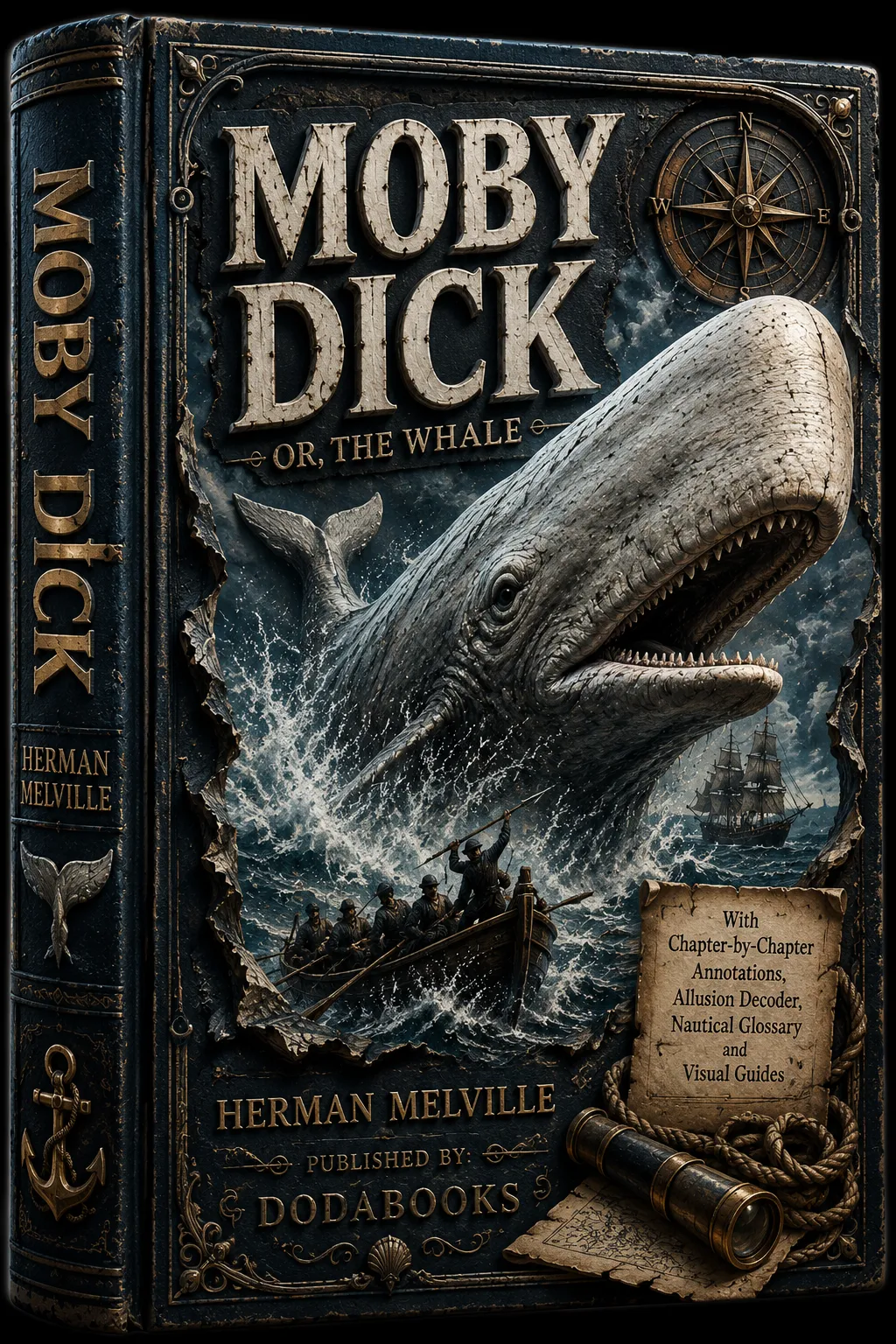
Discover the depth of Melville’s masterpiece with our annotated edition of Moby-Dick. Complete text with explanatory notes, historical context, and literary analysis.
📚 Related Articles
Frequently Asked Questions
Was Moby Dick based on a real whale?
Yes, Melville drew inspiration from Mocha Dick, a notorious albino sperm whale that survived dozens of encounters with whalers off the coast of Chile in the early nineteenth century.
Did Herman Melville actually go whaling?
Yes, Melville sailed aboard the whaling ship Acushnet in 1841, gathering firsthand nautical and cetological knowledge that informed Moby-Dick.
Why did the first edition omit the Epilogue?
The British first edition published by Richard Bentley accidentally omitted the Epilogue explaining how Ishmael survived, confusing contemporary reviewers.
Was Moby-Dick a commercial success during Melville's life?
No, it sold fewer than 4,000 copies in Melville's lifetime and received mixed reviews before its dramatic revival in the 1920s.
Where can I read an annotated edition that explains all these historical facts?
The DodaBooks annotated edition of Moby-Dick includes comprehensive historical notes, cetology commentary, and full contextual background for modern readers.
🎯 Stop Struggling. Start Understanding.
The annotated edition of Moby-Dick gives you everything you need to finally get Melville’s masterpiece:
- ✅ Complete, unabridged text — every word of the original 1851 edition
- ✅ Hundreds of explanatory footnotes — no more Googling every other page
- ✅ Historical context — the Essex disaster, Nantucket whaling, Melville’s life
- ✅ Literary analysis — chapter-by-chapter commentary on themes and symbols
- ✅ Victorian vocabulary — obsolete words and nautical terms defined inline
- ✅ Biblical & literary references — every allusion traced to its source