Burns Night involves a lot of poetry — the Selkirk Grace, the Address to a Haggis, songs, recitations, and the evening always ends with Auld Lang Syne. Here are the ten essential Burns poems you will encounter, with a summary of each and why it matters.
🏴
10 Poems You Need for Burns Night
The ten essential Robert Burns poems for Burns Night — from Auld Lang Syne to Tam o' Shanter — with summaries, key lines, and why each one matters for the celebration.
| Poems Listed | 10 essential Burns poems |
| Range | Love, satire, patriotism, humour, tragedy |
| Difficulty | Easy to Medium |
| Best for Reading Aloud | Address to a Haggis, A Red, Red Rose |
| Best for Singing | Auld Lang Syne, Scots Wha Hae |
| Best for Discussion | Holy Willie’s Prayer, A Man’s a Man |
🌹 1. Address to a Haggis
The Burns Night staple. This comic poem treats the haggis like an epic hero. It is always recited during the haggis ceremony with dramatic gestures and a knife plunged into the haggis at the climax.
Key line: “Fair fa’ your honest, sonsie face, / Great chieftain o’ the puddin’-race!”
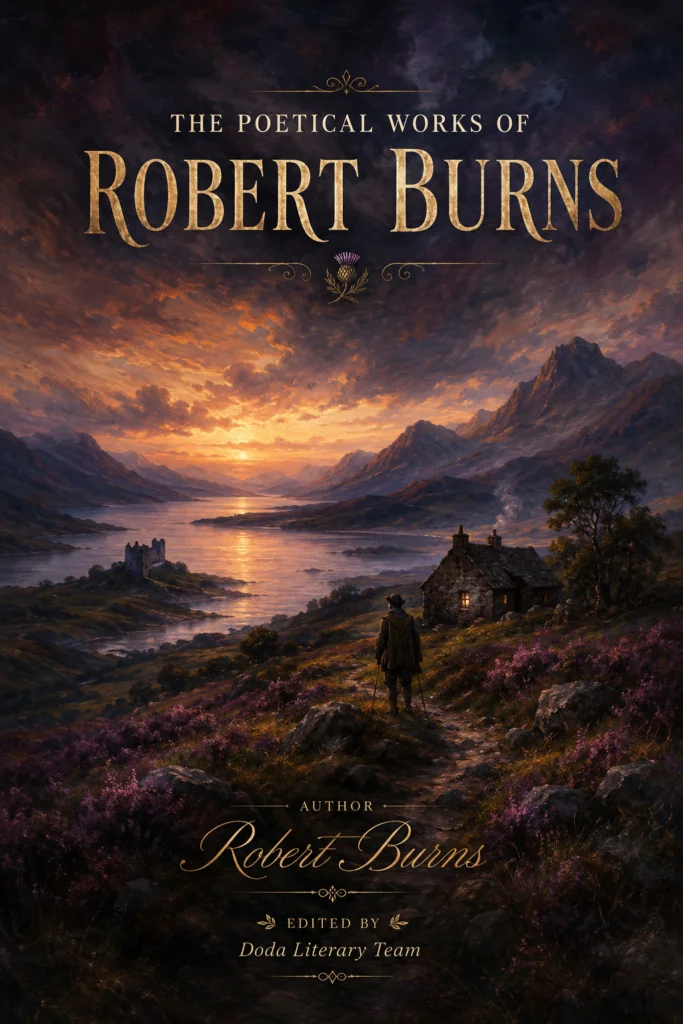
Read it in the annotated edition: The Teacher’s Insights explain the mock-heroic style — Burns uses the language of epic poetry to describe a sheep’s stomach stuffed with offal. That is the joke.
🎵 2. Auld Lang Syne
The world’s most famous New Year song. Burns adapted this from a traditional Scottish folk song. It is sung at Burns Night, Hogmanay, graduations, and funerals worldwide.
Key line: “For auld lang syne, my jo, / For auld lang syne.”
Read it in the annotated edition: The Scots glossary explains the title — auld lang syne means “old long since” or “days gone by.”
🍺 3. Tam o’ Shanter
Burns’s narrative masterpiece. A farmer stays too long at the pub, rides past a haunted church, and barely escapes witches and devils. It is the poem most often read aloud at Burns Suppers after the formal ceremony.
Key line: “Nursing her wrath to keep it warm” — describing Tam’s wife waiting at home.
Read it in the annotated edition: The line-by-line annotations translate the Scots passages. The Teacher’s Insights analyse how Burns blends comedy and horror.
🐭 4. To a Mouse
The poem that gave Steinbeck a title. Burns accidentally destroys a mouse’s nest while ploughing and reflects on the fragility of plans — both animal and human.
Key line: “The best-laid schemes o’ mice an’ men / Gang aft agley.”
Read it in the annotated edition: The Literary Devices section analyses Burns’s use of the mouse as a symbol for human vulnerability.
💕 5. A Red, Red Rose
Burns’s most famous love poem. Short, passionate, and full of memorable similes. It is frequently recited at Burns Night as a lighter piece between the heavier speeches.
Key line: “O my Luve is like a red, red rose / That’s newly sprung in June.”
Read it in the annotated edition: The Literary Devices section discusses Burns’s use of hyperbole (“Till a’ the seas gang dry”) and the ballad form.
📚 All 10 poems with full annotations, Scots glossary, and pronunciation guides
👉 Get the Annotated Edition⚖️ 6. A Man’s a Man for A’ That
Burns’s equality anthem. Written in 1795 during the French Revolution era, it argues that character matters more than rank or wealth.
Key line: “The rank is but the guinea’s stamp, / The man’s the gowd for a’ that.”
Read it in the annotated edition: The Historical Context section explains why this poem was considered politically radical.
💔 7. Ae Fond Kiss
A love poem of parting. Burns wrote this for Agnes McLehose, a lover he was separated from by social convention. The emotional register is darker than A Red, Red Rose.
Key line: “Had we never loved sae kindly, / Had we never loved sae blindly, / Never met — or never parted — / We had ne’er been broken-hearted.”
Read it in the annotated edition: The Poem Summary explains the biographical background.
👿 8. Address to the Deil (To the Devil)
A comic poem about Satan. Burns treats the Devil as a sympathetic figure — almost a victim of his own circumstances. It shows Burns’s irreverent side.
Key line: “O Thou! whatever title suit thee — / Auld Hornie, Satan, Nick, or Clootie.”
Read it in the annotated edition: The Teacher’s Insights discuss Burns’s religious satire.
🙏 9. Holy Willie’s Prayer
Burns’s sharpest satire. A hypocritical church elder prays to God, revealing his own pride, lust, and self-righteousness while believing he is humble. It was considered scandalous in its time.
Key line: “Lord, hear my earnest prayer and cry, / And grant me my petition.”
Read it in the annotated edition: The Historical Context section explains the real-life model for Holy Willie.
⚔️ 10. Scots Wha Hae
Scotland’s unofficial national anthem. Burns wrote this as a war song, putting words in the mouth of Robert the Bruce before the Battle of Bannockburn (1314).
Key line: “Scots, wha hae wi’ Wallace bled, / Scots, wham Bruce has aften led.”
Read it in the annotated edition: The Historical Context section covers the poem’s role in Scottish national identity.
📊 Quick Reference Table
| Poem | Theme | Best For | Length |
|---|---|---|---|
| Address to a Haggis | Scottish identity, comedy | Haggis ceremony | 48 lines |
| Auld Lang Syne | Friendship, memory | Closing song | 5 stanzas |
| Tam o’ Shanter | Supernatural, comedy | Table reading | 224 lines |
| To a Mouse | Empathy, plans | Recitation | 8 stanzas |
| A Red, Red Rose | Love | Reading | 4 stanzas |
| A Man’s a Man for A’ That | Equality, justice | Political toast | 5 stanzas |
| Ae Fond Kiss | Love, loss | Emotional moment | 4 stanzas |
| Address to the Deil | Satire, religion | Humorous reading | 92 lines |
| Holy Willie’s Prayer | Satire, hypocrisy | Discussion | 66 lines |
| Scots Wha Hae | National identity | Patriotic toast | 4 stanzas |
📚 What the Annotated Edition Unlocks
539 Poems Annotated
All 10 poems here plus 529 more — every one with line-by-line explanations
Scots Glossary
500+ Scots words defined and indexed for quick lookup
Teacher's Insights
Stanza-level commentary for every poem explaining literary techniques
Poem Summaries
Overview, context, themes, and devices for each poem
Historical Notes
Explanations of every 18th-century Scottish reference
Beautiful Formatting
Colour-coded card design, works on all major e-readers
❓ Frequently Asked Questions
Which is Burns's most famous poem?
"Auld Lang Syne" is the most famous globally because it is sung worldwide at New Year. But "A Red, Red Rose" and "To a Mouse" are close competitors for recognition.
What is Burns's best poem?
Critics often name "Tam o' Shanter" as his greatest achievement — it combines narrative drive, humour, supernatural elements, and virtuosic Scots language. But "To a Mouse" is arguably his most perfect short poem.
Are all of these poems available in an annotated edition?
Yes — all 10 appear in the Poems and Songs of Robert Burns: Annotated Edition, which contains all 539 poems with full annotations.
Which of these is easiest to read?
"A Red, Red Rose" (short, modern English, simple theme) and "John Anderson My Jo" (gentle, repetitive, easy vocabulary).
Which one should I read on Burns Night?
"Address to a Haggis" is the traditional Burns Night reading, often performed dramatically with a knife before the haggis is carved. "Auld Lang Syne" is sung at the end.
Are there any funny poems on this list?
Yes — "Tam o' Shanter" has comic elements, "Address to a Haggis" is genuinely hilarious, and "To a Louse" is sharp social comedy. Burns had a great sense of humour.